


Decree 291/2026/ND-CP adds a separate penalty group for acts of providing information for tax information exchange. This is an important change for enterprises because responding is no longer a simple administrative task.
According to the source material, the new regulation focuses on Article 19a and applies to taxpayers and related organizations and individuals. Enterprises need to respond on time, fully, accurately, and retain records proving the handling process.
This article summarizes the points enterprises should note, including the scope of change, penalty framework, principle for avoiding duplicate penalties, operational impact, and proposed internal control process.
📌 Key points to remember
- Document — Decree 291/2026/ND-CP dated 21 July 2026, effective immediately from the signing date.
- Focus — adds Article 19a, creating a separate penalty for acts of providing information for tax information exchange.
- Penalty — from VND 10 million to VND 100 million, depending on late, incorrect or incomplete, non-provision, or shielding acts.
- Principle — once penalized under Article 19a, there is no duplicate penalty under Article 14, Article 15, and Article 19.
- Action — enterprises need a receiving contact, deadline tracking, data review, and complete recordkeeping.
Key focus of Decree 291/2026/ND-CP
According to the source material, Decree 291/2026/ND-CP dated 21 July 2026 amends and supplements regulations on administrative penalties for tax and invoice violations. Its focus is adding Section 3 and Article 19a to Chapter II, creating a separate violation group for providing information for information exchange.
The point to note is that the new regulation no longer treats these acts under the general group of providing information for tax administration. When a tax authority request relates to information exchange under law or tax treaties, enterprises need to classify it separately from the receipt stage.
The decree takes effect from the signing date, which is 21 July 2026 according to the source. Therefore, enterprises need to review how they receive official letters, assign responsible contacts, track deadlines, and control data quality before responding.
Paying a penalty does not replace the continuing obligation to provide complete and accurate information to the tax authority.
Comparison between old and new regulations
Before Article 19a, acts related to providing information were usually viewed under the corresponding existing provisions. According to the source, the new regulation helps identify a clearer penalty basis for requests serving information exchange.
The important changes lie in scope, applicable subjects, and penalty levels. Enterprises must not only respond on time but also ensure that information is complete, accurate, and consistent among data-holding departments.
| Details | Old regulation | New regulation |
|---|---|---|
| Regulatory structure | There was no separate provision for this group of acts. | Section 3 and Article 19a are added to Chapter II. |
| Scope of information | Information serving tax administration in general. | Information serving information exchange under law or tax treaties. |
| Applicable subjects | Separated under Article 14, Article 15, and Article 19. | Applies to taxpayers and other related organizations and individuals. |
| Late provision | The penalty framework was lower under the old regulatory groups. | A fine of VND 10–30 million applies if provision is late by 05 days or more. |
| Incorrect or incomplete provision | The penalty framework was lower under the old regulatory groups. | A fine of VND 30–50 million applies for inaccurate or incomplete information. |
Penalty framework under Article 19a
According to the source, Article 19a establishes three main risk groups: late provision, incorrect or incomplete provision, and failure to provide information. In addition, collusion or shielding taxpayers to obstruct tax authorities from collecting and verifying information also falls into the high-penalty group.
- Providing information 05 days late or more may be fined VND 10–30 million.
- Providing inaccurate or incomplete information may be fined VND 30–50 million.
- Failing to provide information after 15 days from the deadline or extended deadline may be fined VND 50–100 million.
- Colluding with or shielding taxpayers to prevent tax authorities from collecting and verifying information may be fined VND 50–100 million.
The remedial measure is compulsory provision of complete and accurate information for acts of providing incorrect, incomplete, or no information. This means enterprises must still complete the obligation to provide information even after being fined.
Application principle to avoid duplicate penalties
The source emphasizes a new point in Article 5: if an act is subject to penalty under Article 19a, it is not penalized under Article 14, Article 15, or Article 19. This is a principle for choosing the correct penalty basis, not a penalty exemption.
In actual operations, the responsible department needs to read tax authority letters or requests carefully. If the request clearly states an information exchange purpose under Vietnamese law, a tax treaty, or an international tax agreement, the enterprise should activate the Article 19a control process.
If the request content is unclear, the enterprise needs to escalate it to management, tax accounting, or a professional support unit. Incorrect classification at the beginning may delay the response, cause missing records, or lead to the wrong control process.
Operational impact on enterprises
Decree 291/2026/ND-CP increases data governance requirements within enterprises. The risk is not only failing to respond, but also responding late, responding incompletely, inconsistent data, or having no evidence of timely submission.
- Enterprises need a contact point to receive requests from the tax authority.
- Enterprises need to record the receipt date, response deadline, and handling status.
- Enterprises need to standardize the steps for compiling, reviewing, and approving information.
- Enterprises need to retain explanatory records, submission documents, receipts, and related emails.
- Enterprises need coordination among accounting, tax, legal, human resources, administration, information technology, and data-holding departments.
For enterprises with multiple departments, data is often scattered across accounting, human resources, banking, sales systems, or operations. Without a process for collecting data and checking consistency, the risk of incorrect or incomplete responses increases significantly.
Proposed internal control process
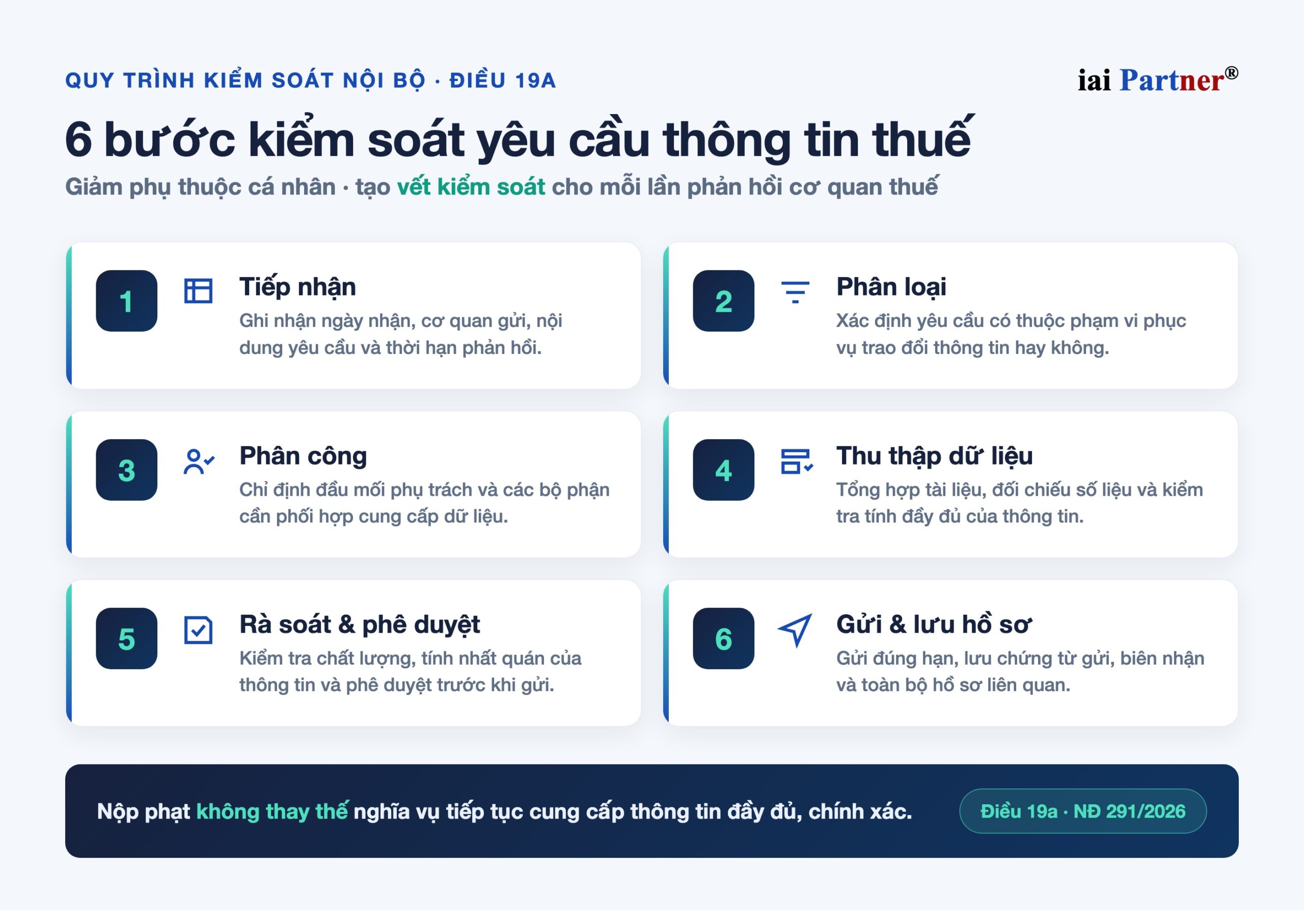
Based on the source content, IAI Partner recommends that enterprises build a six-step process for handling information provision requests. This process reduces dependence on individuals and creates a control trail for each response to the tax authority.
- Step 1: Receive the request and record the receipt date, issuing authority, request content, and response deadline.
- Step 2: Classify the request and determine whether it falls within information exchange purposes.
- Step 3: Assign the responsible contact and identify departments that need to provide data.
- Step 4: Collect documents, reconcile figures, and check information completeness.
- Step 5: Conduct internal review, check information quality, and approve before submission.
- Step 6: Submit on time and retain submission documents, receipts, and all related records.
A control checklist should be used for each official letter or request that appears to fall within Article 19a. Minimum items include scope identification, deadline recording, responsibility assignment, completeness review, accuracy check, internal approval, and post-submission recordkeeping.
What enterprises should prepare now
Enterprises should start by reviewing the process for receiving tax authority requests. If official letters are currently handled across multiple people, the enterprise should clearly define the receiving contact, response contact, and final approval level.
Next, enterprises need to list data that may commonly be requested, such as invoices, documents, cash flows, receivables and payables, personnel records, or information from operating systems. Knowing where data is located shortens response time and reduces reconciliation errors.
Finally, enterprises need to keep a complete trail for each handling case. Records should show the initial request, responsible person, collected data, review step, submitted content, submission time, and evidence confirming submission.
If internal resources are limited, your business may consider using tax accounting service to standardize the process of receiving, reviewing, and recording responses to the tax authority.
Frequently asked questions
What notable content does Decree 291/2026/ND-CP change?
According to the source, the notable point is the addition of Section 3 and Article 19a on penalties for providing information serving tax information exchange.
How much can an enterprise be fined for providing information late?
According to the source, providing information 05 days late or more may be fined VND 10–30 million.
After paying the penalty, must the enterprise still provide information?
Yes. According to the source, the remedial measure is compulsory provision of complete and accurate information for acts of providing incorrect, incomplete, or no information.
Recommendations from IAI Partner
Dear Valued Enterprise,
Decree 291/2026/ND-CP shows that tax information governance requirements are becoming stricter. Enterprises should treat responses to the tax authority as a control process, not merely an act of sending documents.
IAI Partner recommends that enterprises establish a receiving contact point, a deadline tracker, a data review process, and an approval mechanism before submission. These steps help reduce the risk of late responses, missing information, or discrepancies between departments.
Need support? IAI Partner can work with enterprises to review tax processes, standardize response records, and build control checklists suited to actual operations.
Sincerely,
iai Partner®
Source: IAI-Partner.com
Related content
- Supplementary tax filing for enterprises: the 05-year limit
- Proactive accounting: compliance governance for enterprises
- Decree 253/2026/ND-CP: personal income tax 2026
- IAI Partner accounting – tax services
Original document: Decree 291/2026/ND-CP dated 21 July 2026 — look it up at the Government legal documents portal.
Need help? Contact IAI Partner
📞 Hotline: 033 944 7112
📧 Email: hi@iai-partner.com
🌐 Website: iai-partner.com