


📌 Key points to remember
- Three completion gates: Dissolution requires completion of legal, tax and related-agency obligations.
- Identify the status: Statuses 00, 03 and 06 lead to different handling paths and should not be treated with one identical process.
- Use the correct procedure path: The interlinked route and direct tax-registration route use different filing authorities, forms and tracked outcomes.
- Four obligation groups: Declarations, invoices, tax payments and related obligations must all be reviewed before the file is closed.
- Status 06: An enterprise not operating at its registered address must choose tax code termination or restoration based on its actual situation.
Business dissolution is not merely filing documents with the business registration authority. According to IAI Partner's guidance, the process is truly complete only after passing three “gates”: legal, tax and related agencies.
A common cause of delay is handling each part separately while the legal status, tax code status and tax authority notices must be checked together. If the enterprise is no longer operating at its registered address, it must also clearly choose between dissolution and tax code restoration.
Business dissolution must pass through three “gates”
The first gate is legal, including the dissolution decision and the update of the enterprise's dissolved status. The second is tax, where declarations, finalization, tax debts and invoices must be completed. The third covers related obligations such as branches, customs, social insurance or substitute-payment tax codes. If even one part remains unresolved, the process may continue to drag on even after another authority has acknowledged an earlier step.
3 gates
Legal • Tax • Related agencies
The final check should cover the legal status, tax code status and tax authority notice at the same time.

Identify the tax code status correctly before taking action
The material distinguishes three common statuses. Status 00 means active and allows the dissolution process to begin. Status 03 means the enterprise is in the procedure but has not completed tax code termination. Status 06 means it is not operating at its registered address and requires immediate handling through dissolution or restoration. The target for the termination route is status 01, meaning operations have ceased and the tax code termination procedure has been completed.
⚠️ Wrong status, wrong handling path
Enterprises should verify the actual status before preparing forms. Using termination documents for a case that requires restoration, or vice versa, can create unnecessary processing cycles.
Two procedure paths determine where to file and what outcome to track
The first route is the interlinked business-registration mechanism, which the material applies to enterprises, cooperatives and household businesses. A normal dissolution begins and ends with the business registration authority, after which data is transmitted to the tax authority for tax handling. The tax outcome to track under this route is 28/TB-ĐKT. The second route is direct tax registration for organizations or individuals outside the interlinked mechanism, beginning with form 24/ĐKT and ending with 18/TB-ĐKT.
Comparison of the two procedure paths
| Criteria | Interlinked business registration | Direct tax registration |
|---|---|---|
| Starting point | Business registration authority | Tax authority |
| Initial form | According to the business registration file | 24/ĐKT |
| Tax outcome | 28/TB-ĐKT | 18/TB-ĐKT |
Choosing the wrong route often means filing with the wrong authority, using the wrong form and delaying the outcome. Before signing or filing any form, the enterprise should determine whether it falls under the interlinked mechanism or direct tax registration. It looks like a small paper exercise but determines the entire downstream process.
Seven-step dissolution process under the interlinked mechanism
- Review all outstanding obligations before issuing the decision.
- Issue the dissolution decision in accordance with the enterprise's legal file.
- Track 17/TB-ĐKT to confirm that tax code termination is in process.
- Complete declarations, finalization, invoices, tax debts and related obligations.
- Nhận 28/TB-ĐKT after completing tax obligations in the interlinked route.
- File the dissolution dossier after debts have been handled as required by the file.
- Check that the final status has been updated to dissolved.
⚠️ 17/TB-ĐKT is not the final result
The material emphasizes not stopping at 17/TB-ĐKT. It only confirms that tax code termination is in process, while the enterprise must still complete outstanding obligations before reaching the final outcome.
Four obligation groups determine how quickly the file is completed
The first group is declarations and finalization, including VAT, corporate income tax, personal income tax, the final filing period and supplementary filings if any. The second is invoices and accounting records, including erroneous invoices, remaining invoices, financial statements and accounting evidence. The third is tax payments and sanctions, including tax debts, late-payment charges, fines and overpayments. The final group covers related obligations such as customs, branches, substitute-payment tax codes and social insurance. If one obligation remains unresolved, there is not yet enough basis to confirm completion.
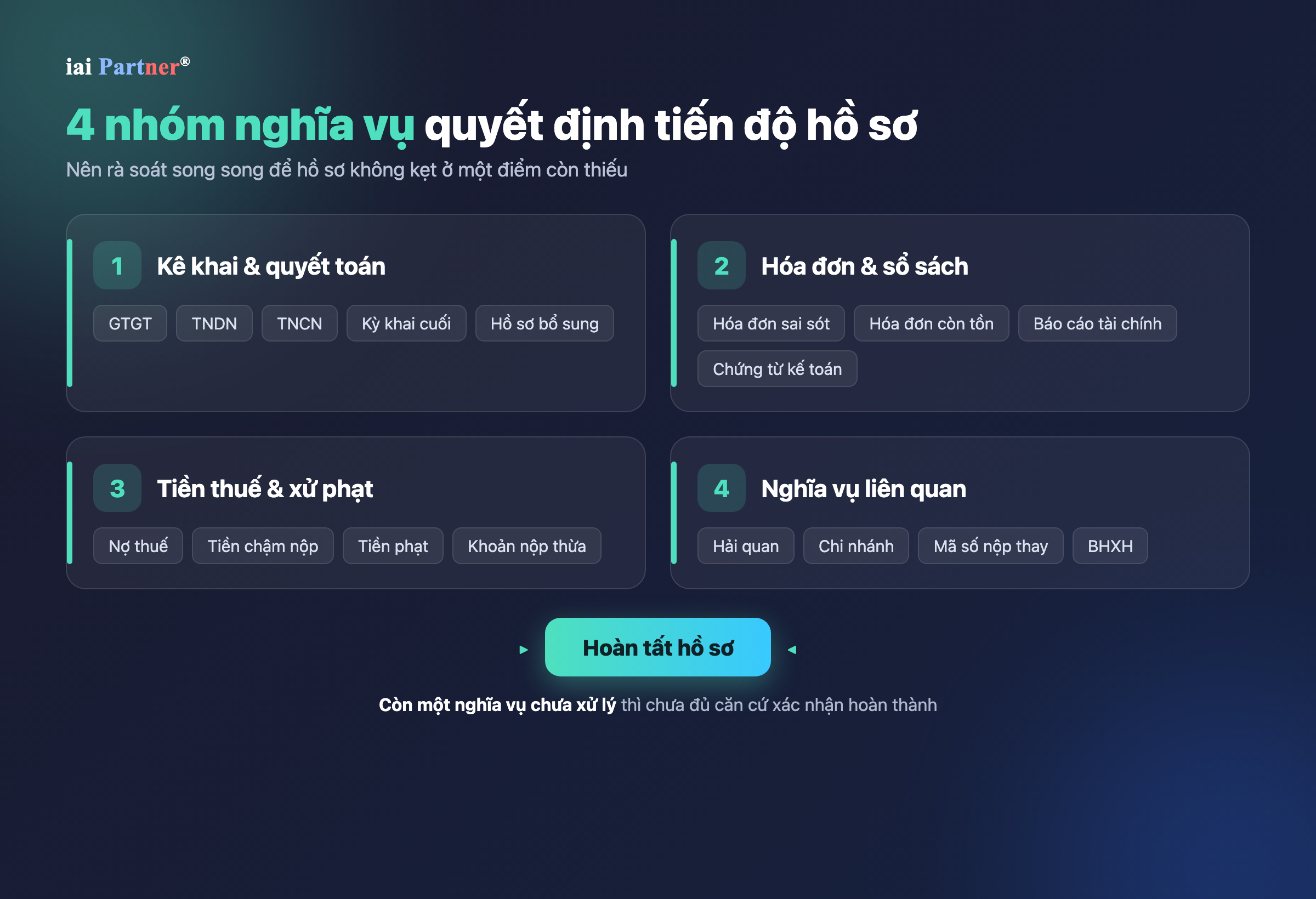
Four deadlines that should not be missed
| Mốc | Task | Lưu ý |
|---|---|---|
| 7 working days | Send the dissolution decision to the business registration authority | According to the deadline stated in the source material |
| 45 days | File finalization documents where applicable | Determine whether the enterprise falls within the applicable case |
| 5 working days | File the dissolution dossier after all debts are paid | Do not treat the period as running before debt obligations are actually completed |
| 10 working days | Tax authority prepares the list of obligations before tax code restoration | Applies to the restoration route according to the source material |
ℹ️ 17/TB-ĐKT is generally issued within 2 working days
According to the source material, the tax authority generally issues 17/TB-ĐKT within 2 working days after receiving a complete file. This is a progress milestone, not proof that all obligations have been completed.
Status 06: dissolution or tax code restoration?
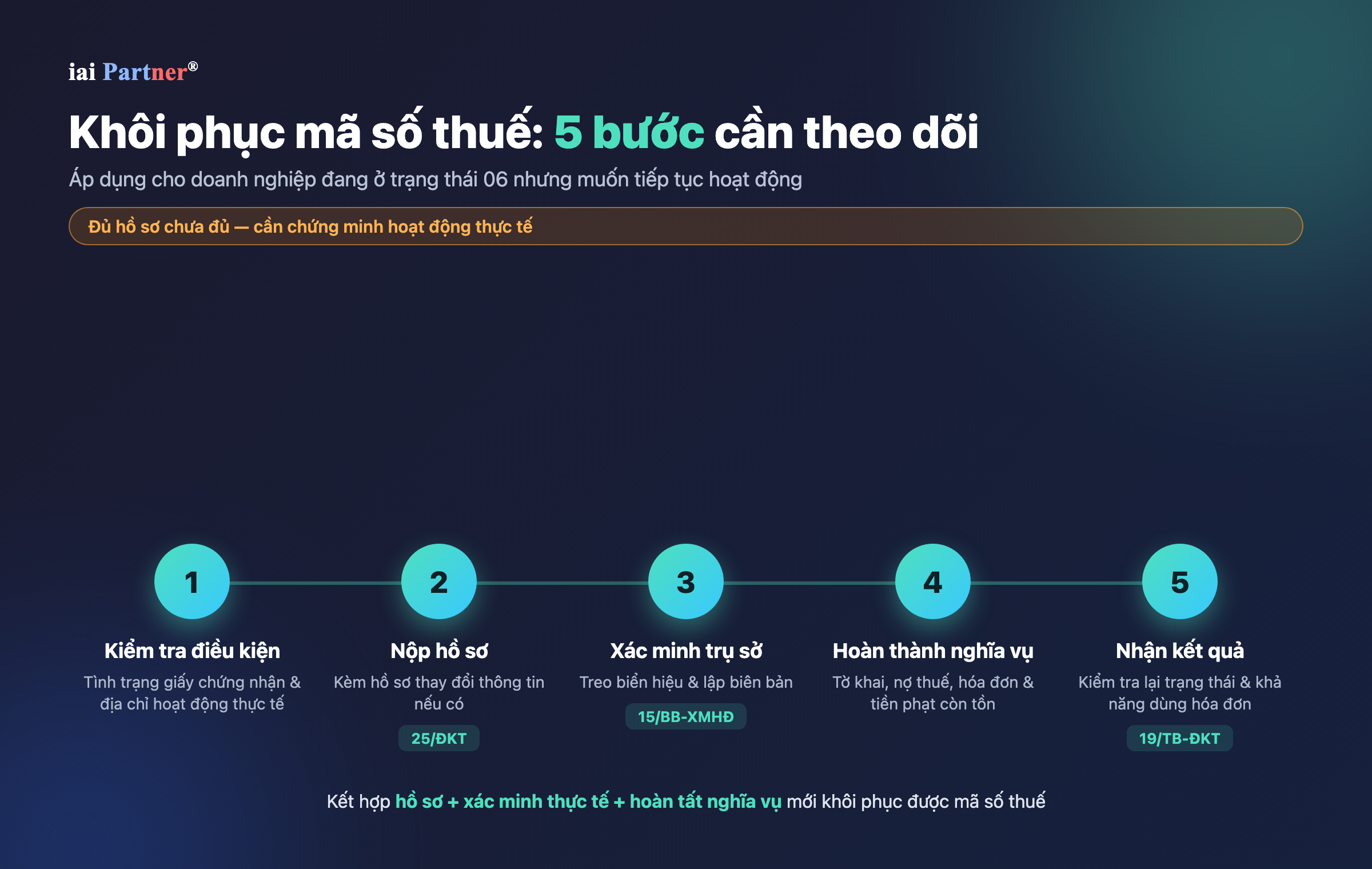
When an enterprise is recorded as not operating at its registered address, the material requires choosing one of two paths. If it will not continue operating, it follows the termination route, completes tax, invoice and sanction obligations, and receives 28/TB-ĐKT or 18/TB-ĐKT depending on the route. If it will continue operating, it files 25/ĐKT, perform address verification, complete the obligations and await19/TB-ĐKT to restore the tax code. Leaving the issue unresolved may continue to restrict use of the tax code and electronic invoicing, according to the material.
Five-step tax code restoration process
- Check eligibility, including certificate status and actual operating address.
- Nộp 25/ĐKT, together with information-change documents if any.
- Complete premises verification, display signage and prepare 15/BB-XMHĐ as required by the file.
- Complete outstanding declarations, tax debts, invoices and fines.
- Nhận 19/TB-ĐKT, then recheck the tax code status and the ability to use invoices.
⚠️ Complete documents are not enough
The material emphasizes that the enterprise must also prove actual operations and complete all obligations. A restoration dossier should therefore not be treated as merely a set of forms.
Checklist before filing
- Confirm the correct tax code status and procedure path.
- Review branches, representative offices and business locations.
- Complete declarations, final filing period, financial statements, books and supporting evidence.
- Resolve erroneous and remaining invoices and reconcile tax debts.
- Reconcile late-payment charges, fines, customs, social insurance and substitute-payment tax codes.
- Retain all notices, minutes and final outcomes to prove completion.
Nguyên tắc vận hành nên giữ rất rõ: the right file • the right authority • the right deadline. These three points reduce refiling, document searches and delays caused by using the wrong route. After each step, the enterprise should retain the result received and reconcile it with the system status. It may feel meticulous, but it is still far better than a dissolution file wandering for months because of one missing document.
Related services at IAI Partner
Frequently asked questions
Is business dissolution completed simply by closing the business registration file?
No. According to the source material, the enterprise must complete legal, tax and related-agency obligations, and check the final status at the same time.
Does receiving 17/TB-ĐKT mean the tax code has already been terminated?
Chưa. 17/TB-ĐKT only shows that the taxpayer is in the process of terminating the tax code. Outstanding obligations must still be completed and the final result tracked.
Can an enterprise in status 06 restore its tax code?
According to the material, if the enterprise continues operating, it may follow the restoration route using 25/ĐKT, verify the head office, complete obligations and receive19/TB-ĐKT when eligible.
Recommendations from IAI Partner
Dear Valued Enterprise,
Before starting business dissolution, conduct an initial review of the tax code status, procedure path and all outstanding obligations. This helps the enterprise know exactly where to file, which form to use and which outcome to track.
If the enterprise is in status 06 but intends to continue operating, the restoration file should include evidence of its address and actual operations, not merely forms. Declaration, tax, invoice and sanction obligations should also be completed based on the actual file.
IAI Partner recommends retaining all notices, minutes and final outcomes from each step. The goal is not merely to finish filing, but to have enough evidence to confirm that the enterprise completed the correct process and reached the correct status.
Sincerely,
iai Partner®
References
- Tax Department – Ministry of Finance — Source of administrative procedures and guidance on terminating and restoring tax code validity.
- Thông tư 90/2026/TT-BTC — Current source on tax registration, effective from 01/7/2026; used to cross-check forms 24/ĐKT, 25/ĐKT and related notices.
- IAI Partner guidance material — The article's direct source, compiling the business dissolution process, tax code statuses, deadlines and an operational checklist.
Source: IAI-Partner.com
Need help? Contact IAI Partner
📞 Hotline: 033 944 7112
📧 Email: hi@iai-partner.com
🌐 Website: iai-partner.com