


Decree 253/2026/ND-CP takes effect on 01/7/2026 and directly affects corporate PIT processes.
Your business needs to review payroll, payments to individuals, withholding records, and finalization plans from the period when they arise.
📌 Key points to remember
- Effective 01/7/2026: Decree 253/2026/ND-CP directly affects the enterprise's PIT process.
- 10% withholding: applies to payments of 5 million VND or more per time to individuals without a long-term labor contract.
- Non-resident individuals: are subject to a 20% tax rate on salary income.
- Review early: update payroll, withholding records, and finalization plans right from the period they arise, without waiting until year-end.
- Transition: tax returns filed before 01/7/2026 under the old regulations do not need to be re-filed.
What businesses need to know before the July 2026 payroll period
Decree 253/2026/ND-CP is not just a change in how tax is calculated, but also a change in how businesses control data. The source emphasizes shifting from experience-based handling to a process with clear classification codes. Each payment to an individual should be identified as taxable, tax-exempt, non-taxable or needing further review. This helps the business reduce risk when preparing payroll, ad-hoc payments and 2026 PIT finalization. If data is not standardized from the start, accountants easily end up handling everything at year-end.
From 2026, PIT processes should shift from year-end calculation to classification at the time of occurrence.
Correctly identify resident and non-resident individuals
The first step is to determine the individual’s residency status because the taxable scope and tax rates are different. Resident individuals are taxed on income arising inside and outside Vietnam. Non-resident individuals are taxed only on income arising in Vietnam, and salary in Vietnam is subject to a 20% rate. Businesses should retain passports, entry and exit records, lease contracts, and foreign residence certificates if available. The more complete the records are, the stronger the basis for residency conclusions during finalization or explanation.
| Criteria | Resident individual | Non-resident individual |
|---|---|---|
| Days present | 183 days or more in a calendar year or 12 consecutive months | Does not meet residency conditions |
| Place of residence | Has a regular residence or leased housing for 183 days or more | Insufficient basis to determine residency |
| Scope of taxable income | Income arising inside and outside Vietnam | Income arising in Vietnam |
| Salaries and wages | Calculated under the progressive tax schedule | Withheld at a 20% tax rate |
Review taxable income and benefits prone to errors
Businesses should not review only salary and bonuses, because many risks sit in allowances, benefits, and payments made on behalf of individuals. The source document lists income groups such as business income, capital investment, capital transfers, real estate, royalties, franchising, inheritance, and gifts. Newer assets such as .vn domain names, carbon credits, auctioned license plates, digital assets, virtual assets, and crypto assets also need to be identified. For each payment, accounting should ask which group it belongs to, whether withholding is required, and whether the retained documents are sufficient. This is the basis for avoiding omitted casual income or benefits paid on behalf of individuals.
- Salaries, bonuses, allowances, and monetary or non-monetary benefits.
- Payments to collaborators, brokers, agents, and individuals providing services.
- Individual loan interest, dividends, transfers of contributed capital, and securities transfers.
- Income from asset leasing, online business, e-commerce, and digital platforms.
- Prizes, royalties, franchising income, inheritance, and gifts.
Withholding and PIT finalization for 2026
Tax withholding should be standardized with clear rules so accountants do not act on intuition. For labor contracts of 3 months or more, corporate accounting service helps withhold under the progressive tax schedule. For individuals without a labor contract or with a contract under 3 months, personal income tax withholding applies where each payment of 5 million VND or more must be withheld at 10% before payment. Common risks are splitting payment vouchers, missing personal tax codes, missing commitments, or applying the wrong rate to long-term contract holders. The business should set three steps: classify the contract, check the payment threshold and keep the commitment records.
| Payment case | Treatment to note |
|---|---|
| Labor contract of 03 months or more | Withhold under the progressive tax schedule |
| No contract or contract under 03 months | Withhold 10% for each payment of VND 05 million or more |
| Non-resident individual receiving salary in Vietnam | Withheld at a 20% tax rate |
| Capital investment income | Withhold at a 5% tax rate |
| Securities transfer | Calculate 0.1% on the transfer price |
Khi PIT finalization in 2026, the business must correctly determine authorized cases and cases where the individual must self-finalize. A person with a labor contract of 3 months at the unit at year-end may qualify for authorization if the relevant rules are met. Cases with medical, education deductions or a tax-reduction request should be guided to self-finalize to declare full records. The source states that monthly or quarterly returns filed from January 1, 2026 to before July 1, 2026 under the old rules do not need to be re-filed. Any difference is adjusted at the 2026 PIT finalization.
Key PIT tax rates to remember (besides salary)
Besides salary taxed under the progressive schedule, your business should quickly grasp the following rates when a payment or other income arises.
| Type of income | Tax rate / calculation |
|---|---|
| Capital investment | 5% |
| Transfer of capital contribution | 20% on taxable income; if cost basis/expenses cannot be determined: 2% on the transfer price |
| Securities transfer | 0.1% on the transfer price |
| Transfer of real estate | 2% on the transfer price |
| Winnings, royalties, franchising, inheritance, gifts | Calculated on the portion exceeding 20 million VND at the corresponding rate |
| Digital assets, virtual assets, crypto assets | 0.1% on the transfer price |
| Salary of non-resident individuals | 20% |
Household and individual businesses: PIT rate on revenue
When advising household businesses, online sellers or individuals leasing assets, the PIT rate on revenue by business sector is as follows.
| Business sector | PIT rate |
|---|---|
| Distribution and supply of goods | 0,5% |
| Services, construction excluding materials | 2% |
| Asset leasing; lottery, insurance, multi-level marketing agents | 5% |
| Manufacturing, transport, services tied to goods; construction including materials | 1,5% |
| Digital information content: entertainment, video games, film, images, music, digital advertising | 5% |
| Other business activities | 1% |
For mixed sectors, the business should split revenue by each activity and not lump it into a single rate when there is a clear basis for classification.
New deductions and records to collect
The source document states two deductions for which businesses should standardize records before finalization. Domestic medical treatment expenses within health insurance coverage have a maximum of VND 23 million per year, provided the expense portion has not been paid by health insurance, the business, or another organization. Domestic education and training expenses of the taxpayer and dependents have a maximum of VND 24 million per year, with lawful documents showing the learner. Businesses should not accept documents as scattered images because that method is hard to check and easy to lose. HR and accounting teams should require a schedule by individual, together with lawful supporting files for each tax year.
| Deduction | Maximum amount | Main condition |
|---|---|---|
| Domestic medical treatment within health insurance coverage | VND 23 million per year | Has invoices and documents, and the expense portion has not been paid by health insurance, the business, or another organization |
| Domestic education and training of the taxpayer and dependents | VND 24 million per year | Has lawful documents showing the learner, taxpayer, or dependent |
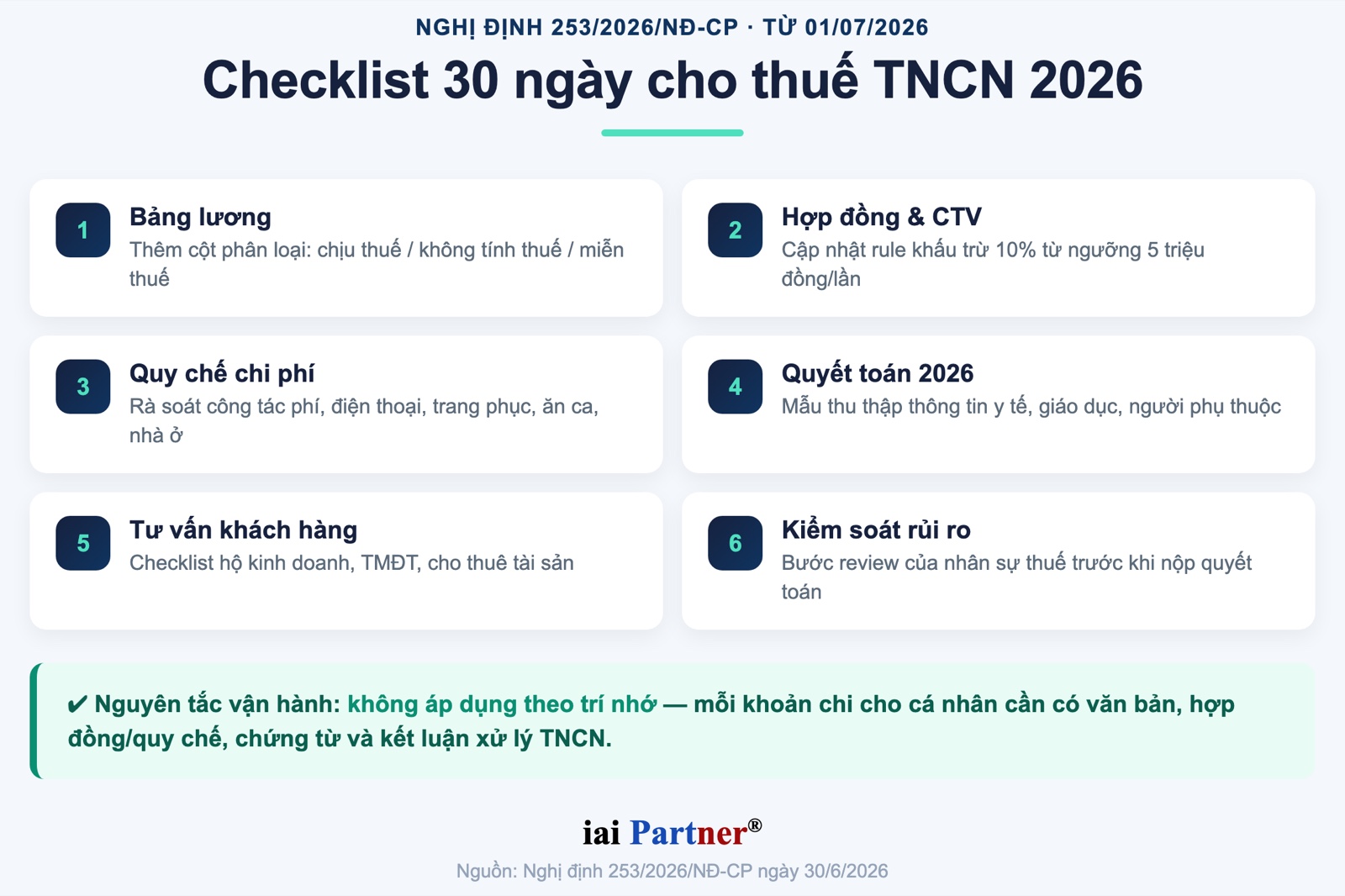
30-day implementation checklist
To adapt to Decree 253/2026/ND-CP, your business should start with the July 2026 payroll process. Early updates help reduce pressure when preparing returns, issuing withholding certificates, and completing year-end finalization. Businesses need coordination among HR, accounting, and tax teams to align forms, responsible persons, and the timing of document collection. The operating principle is not to apply rules from memory, but to have legal documents, contracts, policies, vouchers, and PIT treatment conclusions for each group of payments. When the data system is standardized, businesses can better control costs, taxes, and accountability.
- Add columns classifying taxable, tax-exempt, and non-taxable items to payroll.
- Update the 10% withholding rule for payments from VND 05 million per time.
- Review policies on business travel, phones, uniforms, meals, and housing.
- Design forms to collect medical, education, and dependent information for the 2026 finalization.
- Standardize checklists for household businesses, e-commerce, and individuals leasing assets.
- Create a tax staff review step before filing high-risk dossiers.
Recommendations from IAI Partner
Dear Valued Enterprise,
IAI Partner recommends that your business should not wait until the finalization period to review PIT. The changes under Decree 253/2026/ND-CP should be incorporated into payroll, payment, and recordkeeping processes from July 2026.
Businesses should create a list of payments to individuals, classify tax treatment, and assign responsible reviewers. High-risk payments should be reviewed before payment or before the tax return is filed.
Need support? Your business may prepare payroll, expense policies, and the list of non-payroll payments so IAI Partner can review them by risk group.
Early standardization of records helps businesses reduce errors, avoid year-end backlogs, and respond more proactively when the tax authority requests explanations.
Sincerely,
iai Partner®
Source: IAI-Partner.com
Frequently asked questions
When does Decree 253/2026/ND-CP take effect?
According to the source document, Decree 253/2026/ND-CP takes effect on 01/7/2026 and applies to PIT processes in 2026.
Must businesses refile returns submitted before 01/7/2026?
According to the source document, monthly or quarterly returns filed from 01/01/2026 to before 01/7/2026 under the old rules do not need to be refiled.
Which areas should businesses update first?
Your business should prioritize updating payroll, withholding rules, commitment records, and information collection forms for the 2026 finalization.
Need help? Contact IAI Partner
📞 Hotline: 033 944 7112
📧 Email: hi@iai-partner.com
🌐 Website: iai-partner.com