


📌 Key points to remember
- Effective 10 Sep: The new decree applies from 10 September 2026 , and Decree 12/2022/NĐ-CP ceases to be effective from that date.
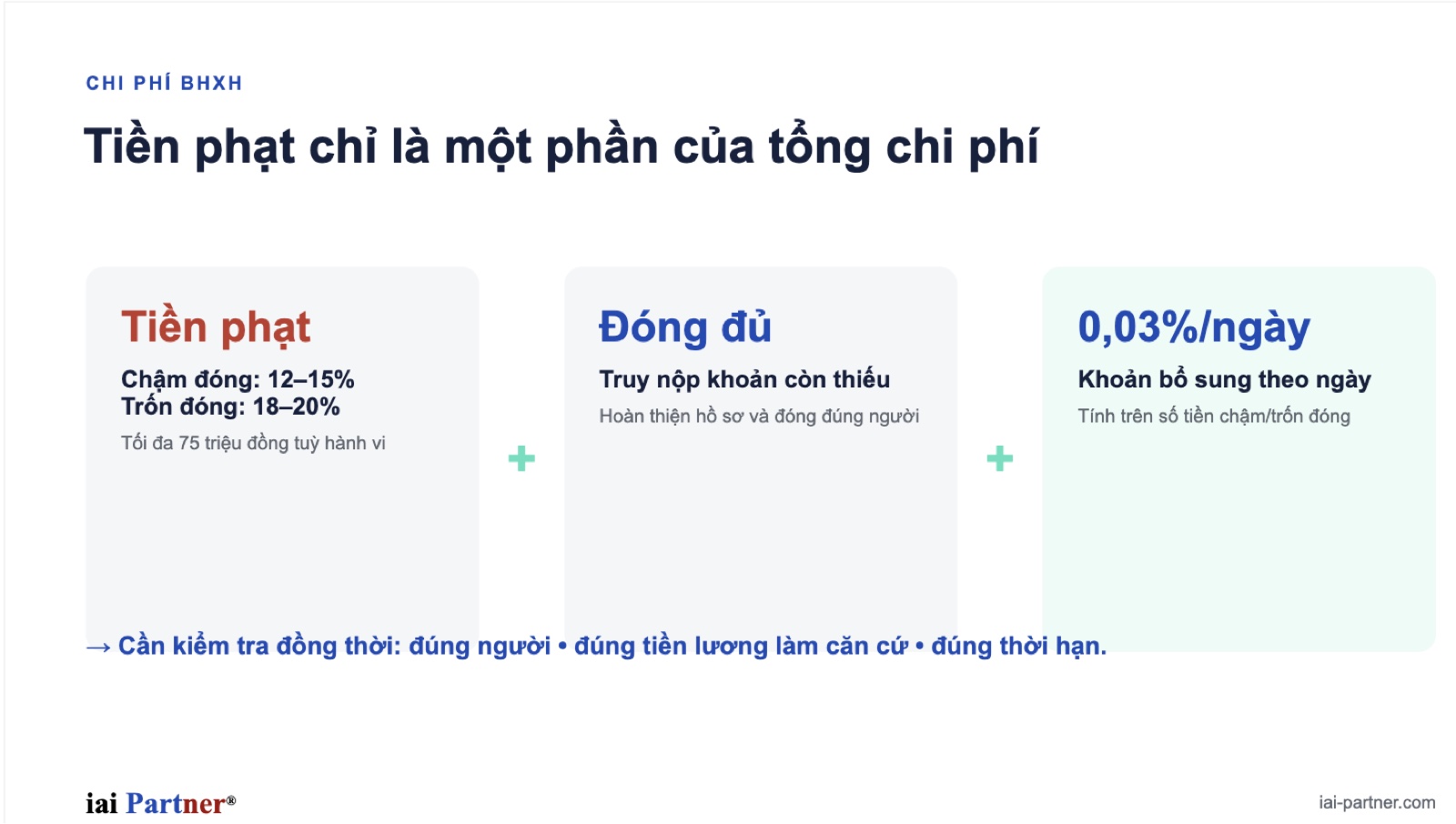
- Social insurance 0.03%/day: Late or evaded social insurance contributions may require full payment plus 0.03% per day , according to the source material.
- Up to VND 50 million: Certain wage violations may be fined up to VND 50 million, while the employer must still restore the employee's related entitlements.
- Article 53: Mức VND 80–100 million range applies only when the conduct satisfies all conditions stated in Article 53, not to every overstay case.
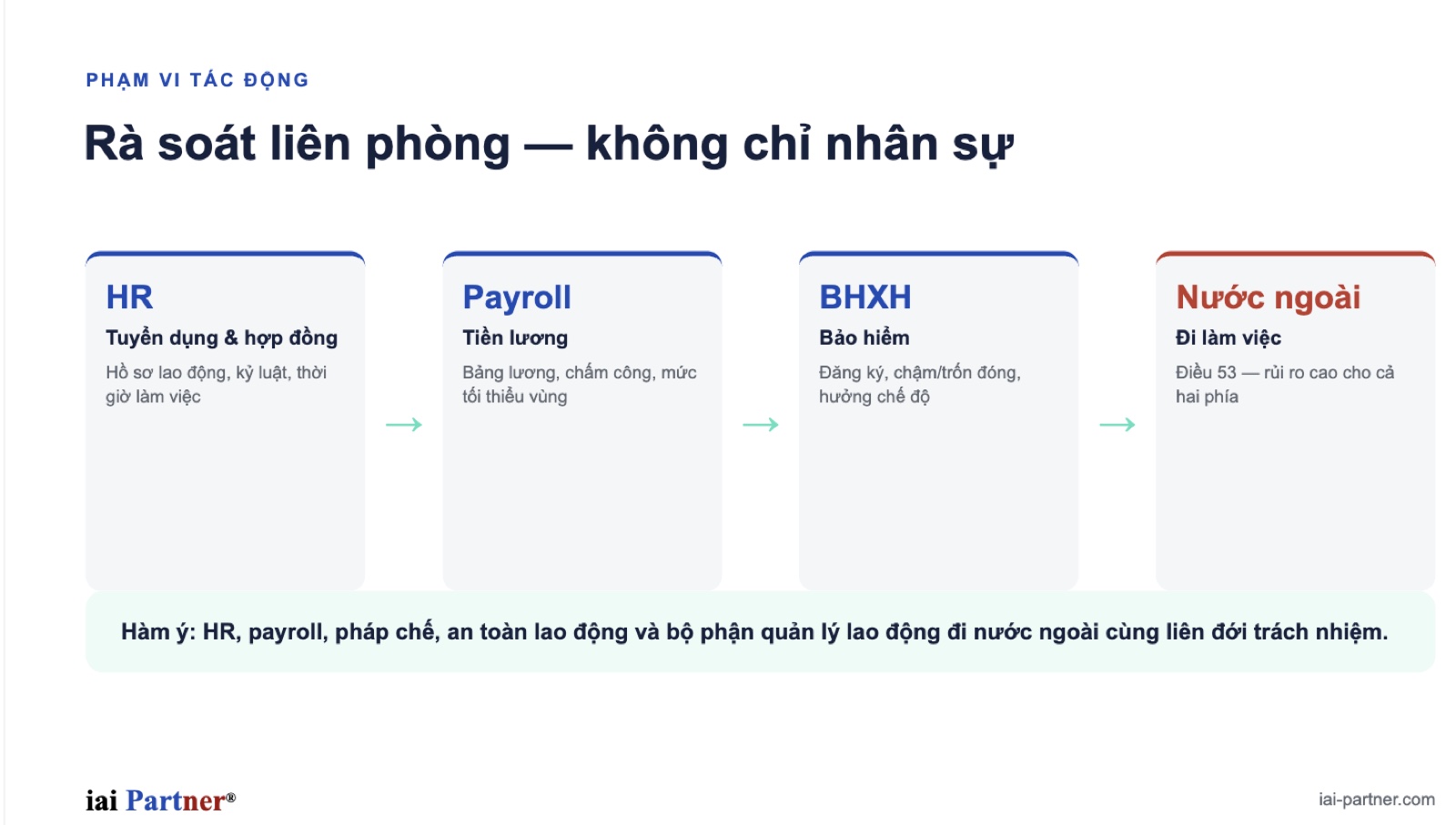
- Cross-functional review: HR, payroll, legal, occupational safety and overseas-work management functions should all participate in the review.
Decree 283/2026/NĐ-CP was issued on 15 July 2026 and takes effect on 10 September 2026, replacing Decree 12/2022/NĐ-CP. The key issue is not only the penalties, but also the need for enterprises to review the entire chain of recruitment, employment and insurance contributions.
For enterprises, preparation should begin with existing compliance evidence: contracts, timekeeping records, payroll, social insurance files and documents related to employees working abroad. Ongoing non-compliance should be prioritized because the transitional rules may bring such conduct within the scope of the new decree.
Decree 283/2026/NĐ-CP changes how enterprises should view compliance risk
The decree contains 6 chapters and 68 articles, covering sanctions in three major areas: labor, social insurance and Vietnamese workers employed abroad under contracts. Because the scope is broad, compliance risk cannot be left to HR alone. The evidence to review is often dispersed across contracts, payroll, attendance records, insurance files, permits and operating documents. Enterprises should therefore examine compliance as an end-to-end process rather than as isolated errors.

ℹ️ More than penalty amounts
Preparation should focus on identifying who is responsible, which records prove compliance and which deficiencies are still ongoing. This approach helps enterprises see the total remediation cost instead of looking only at the administrative fine.
The impact extends beyond the HR department
The labor area covers recruitment, contracts, wages, working time, discipline, foreign workers and occupational safety and health. The insurance area covers participation registration, late payment, evasion, social insurance benefits and unemployment insurance. The overseas-work area concerns service enterprises, vocational training, direct contracts and worker conduct. These three areas can overlap within the same file or operating process.
- HR reviews contracts, recruitment, discipline, working time and labor records.
- Payroll reviews attendance, wages, overtime pay and the basis for social insurance contributions.
- Legal reviews permits, applicable legal bases and the completeness of compliance records.
- Occupational safety and overseas-work management teams review matters within their specialist scope.
Labor errors may trigger both fines and repayment obligations
The source material identifies common issues such as failure to declare, create or present labor-management records, and contracts made in the wrong form, wrong type or without key terms. Risks also arise from late or insufficient wages, unpaid overtime or unlawful deductions. Overtime arranged without consent or beyond permitted limits is another area requiring review. These issues should be checked by employee and by period to determine the actual scope.
VND 50 million
Potential upper wage-related fine
The specific amount depends on the number of affected employees, according to the source material.
A key distinction is that an administrative fine does not replace the obligation to fully restore employee entitlements. According to the source, enterprises may also have to pay all outstanding wages and related amounts, with interest in certain cases. The actual cost of a wage error can therefore be materially higher than the fine shown in a sanction decision. During review, enterprises should determine the repayment amount, the relevant period and evidence that remediation has been completed.
Social insurance: the fine is only part of the total cost
For compulsory social insurance, the source distinguishes three notable situations: late payment, contribution evasion and failure to register all required participants. Late payment is summarized as 12–15% of the late amount, capped at VND 75 million, while evasion is 18–20% of the evaded amount, capped at VND 75 million. In addition to the fine, the first two groups require full payment plus 0.03% per day as remediation. Failure to register all required participants is summarized at VND 6–75 million, depending on the number of employees.
| Conduct | Main penalty | Remediation |
|---|---|---|
| Late compulsory social insurance payment | 12–15% of the late amount; capped at VND 75 million | Pay in full + 0.03%/day |
| Compulsory social insurance contribution evasion | 18–20% of the evaded amount; capped at VND 75 million | Pay in full + 0.03%/day |
| Failure to register all required participants | VND 6–75 million, depending on the number of employees | Create or complete the file and pay in full |
⚠️ Three points to verify together
Enterprises should verify the correct participants, the correct wage basis for contributions and the correct deadlines. Checking only the amount paid while overlooking participant coverage or the contribution basis can leave non-compliance unresolved.
Article 53: the VND 80–100 million range does not apply to every overstay
According to the source material, a worker may face a VND 80–100 million fine for unlawfully remaining abroad on their own initiative after an employment or vocational-training contract ends, provided the relevant conditions are met. The material also identifies similar risk for organizations or individuals without the required function who still advertise, advise, recruit or collect money. Conduct involving coercing, enticing or deceiving workers to remain unlawfully abroad, or falsifying permits, is also flagged. Article 53 therefore should not be reduced to a rule that every immigration overstay automatically attracts this fine.
VND 80–100 million
Risk range stated in Article 53
Applies only when the conduct satisfies all relevant elements and conditions.
⚠️ Do not infer liability from a single sign
For a specific case, review the contractual relationship, termination timing, voluntary conduct, any threat or coercion and possible criminal indicators. The VND 80–100 million range should not be treated as a default figure for every overstay.
Transitional rules: when the conduct ends may determine the applicable rule
The source states that conduct completed before 10 September 2026 is considered under the rules effective when the conduct occurred. From 10 September 2026, Decree 283/2026/NĐ-CP takes effect and Decree 12/2022/NĐ-CP ceases to be effective. If conduct began earlier but continues after the effective date, the material states that it is handled under the new decree. This is why ongoing non-compliance should be prioritized for review and remediation before the effective date.
Comparison by timing of the conduct
| Situation | Timing | Application approach |
|---|---|---|
| Conduct already completed | Trước 10 September 2026 | Apply the rules effective when the conduct occurred |
| New decree takes effect | Từ 10 September 2026 | Decree 12/2022/NĐ-CP ceases to be effective |
| Ongoing violation | Begins earlier and continues afterward 10 September 2026 | Apply Decree 283/2026/NĐ-CP according to the source material |
Enterprises should create a separate list of conduct that may continue beyond 10 September 2026, rather than reviewing only closed files. The list should identify the owner, impact scope, missing data and remediation deadline. This creates governance evidence that the enterprise identified and addressed non-compliance before the new decree took effect. Where the end date of conduct is disputed, the official text and actual records should be checked before reaching a conclusion.
A four-step review plan before the effective date
Step 1: Define the scope
First, enterprises should identify which entities, employee groups and processes fall within the review scope. Starting by collecting every file before defining the risks can consume time while still missing cross-functional gaps. The scope should follow the three chains already identified: labor, insurance and overseas work. Each chain should have a responsible owner and a defined list of required data.
Step 2: Reconcile the data
Next, reconcile contracts, attendance records, payroll, social insurance files and overseas-work records for the same employee groups. The goal is not only to find missing documents but also to detect inconsistencies across systems. A wage amount in the contract, another in payroll and a different basis in the social insurance file is a signal requiring review. Likewise, contract termination dates should align with related records when the enterprise evaluates risk under the transitional rules.
Step 3: Prioritize remediation
Ongoing issues should be addressed first, especially underpaid social insurance, unpaid wages, incomplete permit files or processes lacking approval evidence. Each issue should have an owner, required action, deadline and proof of completion. If data is corrected without retaining evidence, the enterprise may still struggle to prove remediation later. Prioritization should also consider the number of affected employees, duration and the potential for additional financial obligations.
Step 4: Standardize controls
After priority issues are addressed, the enterprise should convert review findings into recurring controls. Records should have an owner, update deadline, evidence repository and clear approval step. Data linking payroll, social insurance and contracts should have reconciliation checkpoints before each period is closed. The final goal is to move from “knowing the rules” to “proving compliance” with records that can be rechecked.
Related services at IAI Partner
Frequently asked questions
When does Decree 283/2026/NĐ-CP take effect?
According to the official sources checked, the decree takes effect on 10 September 2026. From that date, Decree 12/2022/NĐ-CP ceases to be effective.
Is paying the fine enough for late social insurance contributions?
No. According to the source, in addition to the fine, the enterprise must pay the full late amount and an additional 0.03% per day under the stated remediation measure.
Does every worker who overstays abroad automatically face a VND 80–100 million fine?
It should not be understood that way. The source emphasizes that the VND 80–100 million range applies only when the conduct satisfies all elements of Article 53 and the related conditions.
Recommendations from IAI Partner
Dear Valued Enterprise,
Between now and 10 September 2026, enterprises should prioritize ongoing non-compliance and files that lack sufficient compliance evidence. The review should have a responsible owner, a clear scope and a completion deadline for each workstream.
The penalty figures in this article summarize the source material and should be considered together with remediation obligations to assess total cost correctly. For an actual case, the enterprise should also verify the applicable subject, timing of conduct and required elements before reaching a conclusion.
IAI Partner recommends converting review findings into an action list with owners, deadlines and completion evidence. The goal is to ensure that every compliance point can be rechecked through specific records rather than relying only on internal explanations.
Sincerely,
iai Partner®
References
- Government Legal Documents Portal — Official source to cross-check Decree 283/2026/NĐ-CP, its issuance date and effective date.
- Official Electronic Gazette — Official gazette source for Decree 283/2026/NĐ-CP.
- Nghị định 283/2026/NĐ-CP — The officially signed version should be cross-checked when applying to each specific case.
Source: IAI-Partner.com
Need help? Contact IAI Partner
📞 Hotline: 033 944 7112
📧 Email: hi@iai-partner.com
🌐 Website: iai-partner.com