


Determining the nature of a voucher is the first step before deciding when to issue an invoice. The label “gift voucher” does not automatically mean the transaction has been completed. Enterprises must identify whether the holder receives goods, a specific service, a multi-purpose payment right, or contractual security.
From 01/07/2026, Decree 254/2026/NĐ-CP and Circular 91/2026/TT-BTC are the key references in the source material. The Decree sets invoice principles and timing, while the Circular guides implementation mechanisms. Misclassification may cause premature invoices, duplicate invoices, or insufficient supporting records.
📌 Key points to remember
- Determine the substance first — the labels “voucher” or “gift card” do not indicate whether the transaction is complete.
- Four types — specific goods, specific service, multi-purpose card, and deposit; each has a different invoice timing.
- Basis — from 01/07/2026, Decree 254/2026/ND-CP and Circular 91/2026/TT-BTC apply.
- Circular 91 — guides delegation and invoice handling, but does not classify vouchers for the enterprise.
- Risk — misclassification causes premature invoices, duplicates, omitted revenue, or incomplete expense records.
Do not determine invoice timing solely from the term voucher
Enterprises often use voucher, gift card, or purchase coupon as general labels for many programs. However, each program may grant the holder a completely different right. Some vouchers are tied to goods, some identify a service, and some cards allow multiple choices. Certain receipts may also be deposits securing contractual performance.
According to the source material, the safe principle is to clearly prove when the actual sale of goods or provision of services occurs. Enterprises should describe the holder’s rights, conditions of use, scope of goods or services, and payment flow. The more ambiguous the records, the greater the risk of choosing the wrong invoice timing. Accounting should be involved when the program is designed, not only at period end.
Correctly identifying the transaction is essential for issuing invoices at the right time and avoiding misstated revenue.
Four transaction types to classify before issuance
The decision framework in the material divides vouchers into four main groups based on the right actually received by the holder. Classification must be completed before sales issues codes or collects money. This is not solely an accounting responsibility because sales terms are often designed by commercial and operations teams. All departments should agree on one interpretation before launching the program.
| Transaction type | How to determine invoice timing |
|---|---|
| Voucher for specific goods | Issue the invoice when ownership or the right to use the goods is transferred. |
| Voucher for a specific service | If payment is collected before or during provision, issue the invoice when payment is collected. |
| Multi-purpose card | Consider issuing the invoice when the customer actually uses it; rules and reconciliation data are required. |
| Deposit | Apply the exception only when the receipt genuinely secures contract formation or performance. |
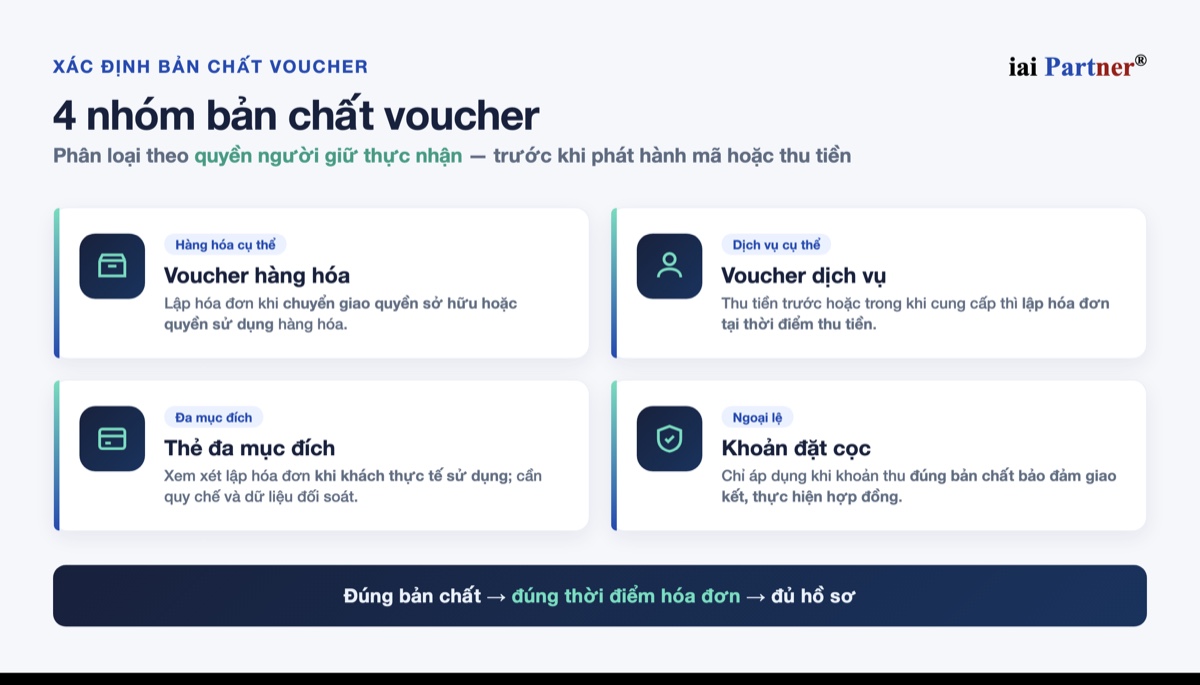
The table is a starting point and does not replace reviewing the contract and specific terms of use. Two programs with the same voucher label may be treated differently if holders receive different rights. Enterprises should retain a product description, money flow, and grounds for invoice timing. These records support consistent operations and explanations when required.
Goods vouchers and service vouchers have different invoice timing
For vouchers used at supermarkets, fashion stores, or retail chains, selling a code does not necessarily mean goods have been delivered. If the buyer only receives a card and has not selected specific goods, the enterprise should track the money, voucher code, and terms of use. The invoice is considered when goods are actually delivered to the user. If ownership transfers earlier, the enterprise should not automatically wait until redemption.
For a voucher that clearly identifies a service, invoice timing is directly affected by when payment is collected. The material gives examples such as one hotel night, a spa package, buffet, or training course. If payment is collected before or during provision, the invoice is issued when payment is collected. The contract and terms of use must align with accounting and invoice issuance.
Multi-purpose cards and deposits require careful treatment
At sale, a multi-purpose card often does not identify the goods, service, tax rate, or specific provider. The source material treats invoicing when the customer actually uses the card as an application view. It is not a standalone rule automatically applicable to every voucher model. High-value, multi-party, or complex cash-flow programs should seek guidance from the directly managing tax authority.
Enterprises should not rename an advance payment as a “deposit” merely to delay invoicing. The exception is appropriate only when the money genuinely secures contract formation or performance under its civil-law nature. Refund terms, usage rights, and the parties’ obligations must reflect that substance. The label on a receipt cannot replace the actual transaction content.
Circular 91 guides implementation but does not classify vouchers for enterprises
Circular 91/2026/TT-BTC supports enterprises on delegated electronic invoicing and handling issued invoices. When delegating to a third party, the parties need a written contract or agreement and must register as required. The invoice must show information on both the delegating and delegated parties. The delegation should also be disclosed so purchasers are aware.
When an invoice contains errors, enterprises should distinguish non-material errors from errors involving money, tax rates, or the transaction. If a service is cancelled or terminated after payment has been collected, the invoice must be adjusted. The Circular does not decide whether a voucher is goods, a service, or a payment instrument. Determining the nature of the voucher remains the enterprise’s first responsibility.
Purchaser records and controls before issuance
An enterprise buying vouchers for customers or employees cannot keep only one invoice and consider the file complete. The expense should relate to business activities, customer care, promotion, or a clear welfare policy. Records should include decisions, rules, contracts, code lists, handover minutes, and recipient lists. According to the source, each payment of VND 5 million or more must satisfy non-cash payment conditions.
Before issuance, enterprises should describe the holder’s rights, classify the transaction, and confirm invoice timing. The system must track codes, face values, usage status, redemption dates, and remaining balances. Contracts, payment records, handover documents, and reconciliation data should be standardized together. Errors in program design often cause duplicate invoices, omitted revenue, or incomplete expense records.
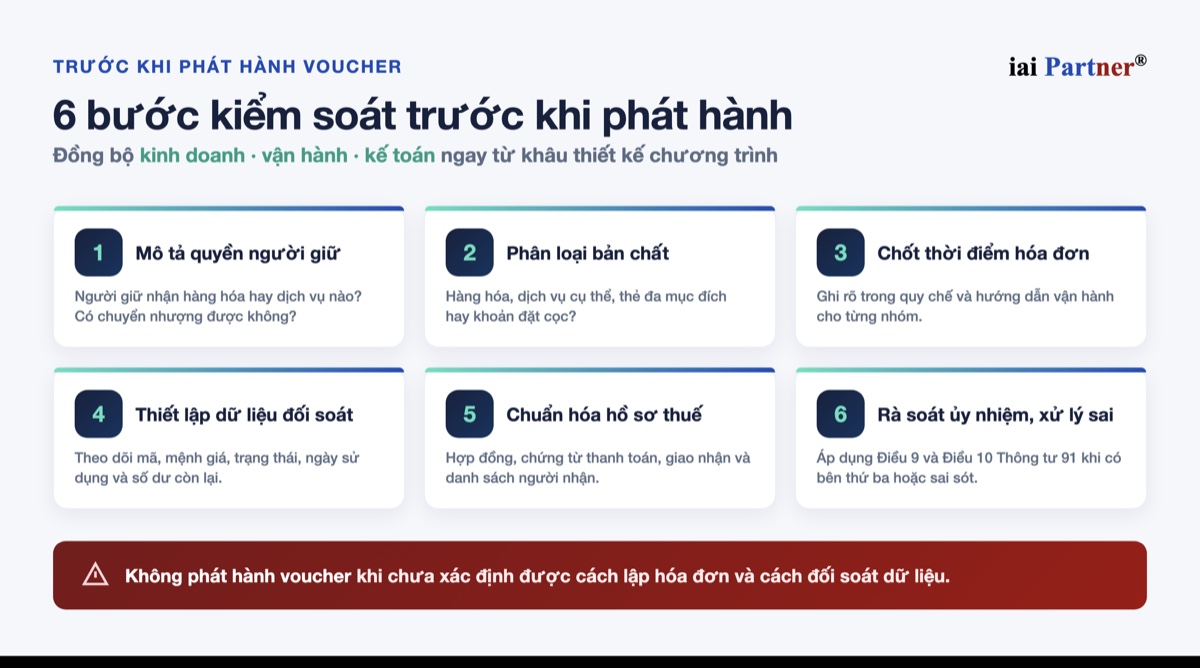
Do not issue vouchers until the enterprise has determined how invoices will be issued and how data will be reconciled.
Determining the nature of a voucher connects three requirements: correct invoice timing, correct revenue, and sufficient records. For complex models, enterprises should review terms of use, money flows, and each party’s role before launch. Early control is usually much simpler than later invoice adjustments and explanations. This is the foundation for safe and consistent voucher operations.
To tie voucher records to the accounting process from the outset, your enterprise may use the declaration management & tax accounting service and refer to the new e-invoice rules under Decree 254/2026/ND-CP.
Frequently asked questions
Must an invoice be issued immediately when a voucher is sold?
The answer cannot be based on the voucher label alone. Enterprises must determine whether it represents goods, a specific service, a multi-purpose card, or a deposit. Each transaction type leads to a different invoice timing.
When is an invoice issued for a service voucher paid in advance?
According to the source material, if a voucher clearly identifies the service and payment is collected before or during provision, the invoice is issued when payment is collected. A deposit is an exception only when it genuinely secures contractual performance.
How should invoices be handled for multi-purpose cards?
The material treats invoicing when the customer actually uses the card as an application view. Enterprises need clear rules, reconciliation data, and supporting records. Large or multi-party models should seek guidance from the directly managing tax authority.
Recommendations from IAI Partner
Dear Valued Enterprise,
Vouchers are not a single uniform transaction type. Under the same label, the holder’s rights and the timing of goods or services may be entirely different.
IAI Partner recommends determining the transaction’s nature before launching the program. Voucher rules, payment flows, invoice timing, and reconciliation data should be designed together.
Need support? IAI Partner assists in reviewing voucher models, tax records, and invoice issuance processes. The goal is to help enterprises apply the correct substance, timing, and supporting grounds.
Sincerely,
iai Partner®
Source: IAI-Partner.com
Related content
- Declaration management & tax accounting service
- Decree 254/2026/ND-CP: preparing for e-invoices
- Decree 291/2026/NĐ-CP: controlling requests for tax information
- Disaster Prevention and Control Fund: compliance and penalties
- Corporate accounting & finance knowledge
Need help? Contact IAI Partner
📞 Hotline: 033 944 7112
📧 Email: hi@iai-partner.com
🌐 Website: iai-partner.com