


The Disaster Prevention and Control Fund is a financial obligation that many enterprises overlook while focusing on tax, insurance, and payroll. However, failing to track notices, identify the correct liable parties, or retain supporting documents can create compliance risks. Enterprises should manage this obligation as part of their annual legal and accounting calendar.
The source material identifies the Disaster Prevention and Control Fund as an off-budget state financial fund used for disaster prevention, response, and recovery. Relevant parties include employees, enterprises, and cooperatives, with certain exemption or reduction cases. The management focus is not merely payment, but accurate calculation, timely payment, proper accounting, and complete record retention.
📌 Key points to remember
- Basis — the Law on Natural Disaster Prevention and Control (current consolidated text), Decree 78/2021/ND-CP, and Decree 63/2025/ND-CP.
- Parties — employees, enterprises, and cooperatives; certain cases qualify for exemption or reduction under regulations.
- Contribution — employees pay one day of salary per person per year; enterprises pay based on asset value, from VND 500,000 to VND 100,000,000 per year.
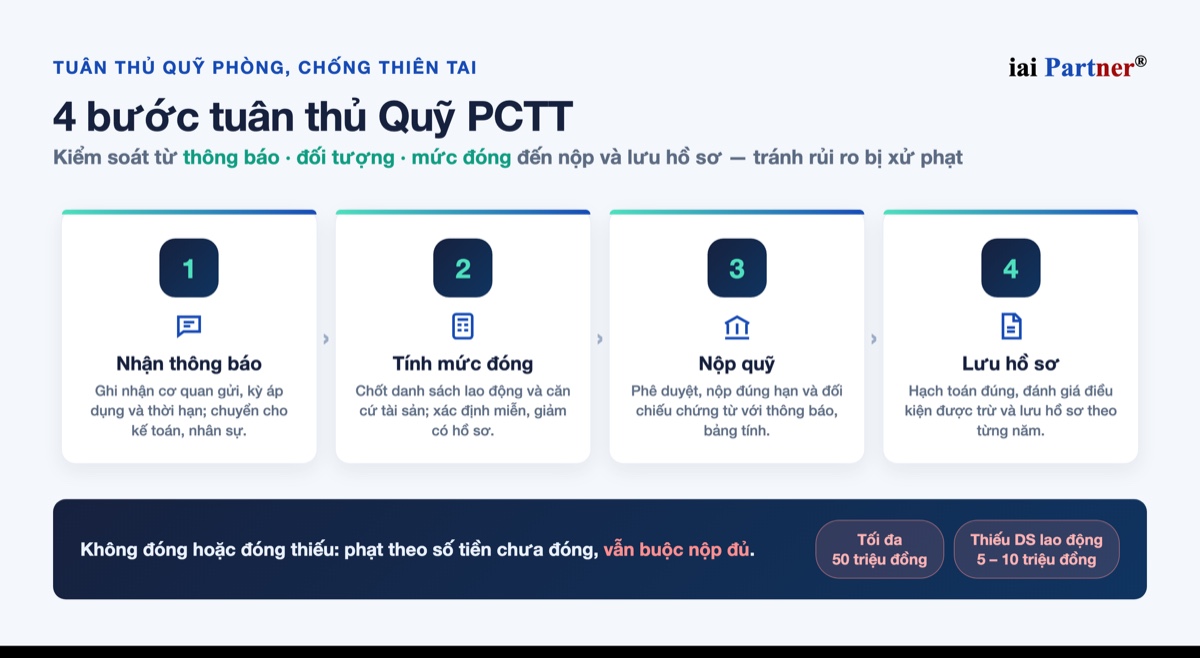
- Process — receive the notice, calculate the contribution, pay the fund, and retain records; each step has an owner and evidence of completion.
- Penalties — failure to contribute or underpayment is fined based on the unpaid amount, up to VND 50,000,000, with the full obligation still due; missing the employee list is fined VND 5,000,000 to VND 10,000,000.
The Disaster Prevention and Control Fund is a compliance obligation, not an optional contribution
The Disaster Prevention and Control Fund is established to provide financial resources for disaster prevention, response, and recovery. According to the source material, it is an off-budget state financial fund applying to individuals, enterprises, and organizations within the regulated scope. Enterprises therefore should not treat a contribution notice as an administrative request that can be handled whenever convenient.
The legal bases listed in the material include the current consolidated Law on Natural Disaster Prevention and Control, Decree 78/2021/ND-CP, and Decree 63/2025/ND-CP. Enterprises should compare their actual circumstances with the notice and the rules applicable at the time of performance. The existence of exemption or reduction cases does not allow an enterprise to make its own conclusion without supporting grounds and documentation.
Compliance with the Disaster Prevention and Control Fund does not end with transferring money; an enterprise must demonstrate that it correctly identified the liable parties, contribution amount, and related records.
Parties and contribution levels enterprises must review
The source material identifies employees, enterprises, and cooperatives as groups whose contribution obligations must be reviewed. For employees, the stated contribution is one day of salary per person each year. For enterprises, the amount is determined based on asset value and ranges from VND 500,000 to VND 100,000,000 per year.
Enterprises should clearly separate the organization's obligation from the portion connected to the employee list. Errors often arise when personnel records are outdated, workforce changes are not reflected, or exemption and reduction files are incomplete. Accurate calculation must begin with supported employee and asset data rather than simply copying figures from the previous period.
| Group to review | Source-based requirement | Enterprise control point |
|---|---|---|
| Employees | One day of salary per person each year | Employee list, personnel changes, and exemption or reduction records |
| Enterprises and cooperatives | Contribution based on asset value, from VND 500,000 to VND 100,000,000 per year | Asset basis, contribution notice, and payment evidence |
| Exemption or reduction cases | Certain cases may qualify for exemption or reduction under regulations | Do not apply without supporting grounds and documentation |
Enterprise compliance process for the Disaster Prevention and Control Fund
The source material proposes a four-step process: receive the notice, calculate the contribution, pay the fund, and retain records. Each step should have an owner, an internal deadline, and evidence of completion. If the task is assigned to one individual without review, the enterprise may overlook a notice or use outdated data.
Step 1: Receive and classify the notice
Upon receiving a notice, the enterprise should record the issuing authority, applicable period, relevant parties, and completion deadline. The notice should be shared with accounting, human resources, and the authorized approver. Retaining the original or electronic version from the outset prevents loss and creates an audit trail.
Step 2: Identify liable parties and calculate the contribution
Accounting should coordinate with human resources to finalize the employee list and identify workforce changes during the period. At the same time, the enterprise must review the asset basis used to determine the organization's obligation. The calculation sheet should show data sources, the calculation method, exemption or reduction cases, and the final reviewer.
Step 3: Approve, pay, and reconcile
Before payment, the calculation should be reviewed against the employee list, asset basis, and required amount. After payment, accounting must reconcile the bank evidence or receipt with the notice and approved calculation. Even a small unresolved difference may become an unpaid balance during an authority review.
Step 4: Account for and retain records
The source material requires proper accounting, retention of evidence, and attention to the conditions for deductibility. Enterprises should retain the notice, employee list, calculation, exemption or reduction files, internal approval, and payment evidence by year. Complete records support prompt explanations and reduce dependence on the individual who previously handled the task.
To reduce reliance on one individual, your enterprise may assign the calculation and record retention to the declaration management & tax accounting service and coordinate with the human resources & payroll management service to finalize the employee list for the correct period.
Penalties and consequences of enterprise non-compliance
According to the source material, failure to contribute or incomplete contribution may be penalized based on the unpaid amount, with a maximum fine of VND 50,000,000. In addition to the fine, the enterprise must pay the full outstanding obligation. This shows that paying a penalty does not replace the duty to complete the mandatory contribution.
The material also states a fine from VND 5,000,000 to VND 10,000,000 for failing to provide the employee list. This risk is significant because personnel data is usually managed by another department while accounting receives the notice. Without a coordination process, an enterprise may be penalized even when funds are available for payment.
| Conduct to avoid | Sanction stated in the source | Management consequence |
|---|---|---|
| Failure to contribute or incomplete contribution | Fine based on the unpaid amount, up to VND 50,000,000 | The outstanding obligation must still be paid in full |
| Failure to provide the employee list | Fine from VND 5,000,000 to VND 10,000,000 | Additional explanation and personnel data submission are required |
| Failure to retain payment or calculation records | The source does not state a separate fine | Difficulty proving proper compliance, accounting, and calculation |
Common compliance errors and how to control them
The first common error is missing a notice because it reaches one contact point but is not forwarded to accounting or the responsible person. The second is using an outdated employee list, causing omissions, duplication, or incorrect exemption and reduction treatment. The third is making payment without retaining complete evidence, making it difficult to prove completion of the obligation.
Enterprises should maintain a unified compliance calendar covering tax, insurance, labor, and Disaster Prevention and Control Fund obligations. Each obligation should have a primary owner, a data provider, and an approver. Deadline reminders and checklists reduce reliance on individual memory while creating a clear control trail for each compliance period.
- Designate one primary notice recipient and one backup.
- Reconcile the employee list with current personnel data at the calculation date.
- Retain the basis for determining enterprise assets and contribution amount.
- Review exemption or reduction files before including them in the calculation.
- Reconcile payment evidence with the notice and approved amount.
- Retain records by year for accounting, review, and explanation.
Compliance checklist before closing the contribution period
A checklist helps the enterprise control the full process from notice receipt to record retention. Each item should have a confirming person and attached evidence rather than a simple completion mark. During an inspection, the enterprise can immediately present the calculation basis, payment evidence, and relevant employee data.
- The notice from the competent authority has been received and retained.
- The liable, exempt, and reduced-contribution parties have been correctly identified.
- The employee list and supported asset data have been finalized.
- The contribution has been calculated and independently reviewed.
- Payment was made on time and all payment evidence was reconciled.
- The amount has been accounted for, deductibility conditions reviewed, and records retained by year.
Frequently asked questions
Is an enterprise required to contribute to the Disaster Prevention and Control Fund?
According to the source material, enterprises and cooperatives are among the groups whose contribution obligations must be reviewed. Certain cases may qualify for exemption or reduction, but supporting grounds and documentation are required before application.
If an enterprise does not contribute, is paying the fine enough?
No. The source states that an enterprise may be fined based on the unpaid amount, up to VND 50,000,000, and must also pay the full outstanding obligation.
Can the Disaster Prevention and Control Fund contribution be treated as a deductible expense?
The source material states that the contribution may be deductible when all conditions are satisfied. Enterprises should account for it correctly and retain the notice, calculation, approval, and payment evidence for review purposes.
Recommendations from IAI Partner
Dear Valued Enterprise,
The Disaster Prevention and Control Fund should be included in the annual compliance calendar alongside tax, insurance, and labor obligations. Enterprises should control the process from notice receipt and liable-party identification to calculation, payment, and record retention.
The contribution may be far lower than the cost of penalties, supplemental documentation, and explanations. Enterprises should particularly avoid failing to provide the employee list or using outdated personnel data.
Need support? IAI Partner assists with reviewing liable parties, contribution amounts, accounting records, and compliance checklists. The objective is to help enterprises meet obligations on time, maintain complete evidence, and reduce penalty risks.
Sincerely,
iai Partner®
Source: IAI-Partner.com
Related content
- Declaration management & tax accounting service
- Human resources & payroll management service
- Decree 291/2026/NĐ-CP: controlling requests for tax information
- Decree 296/2026/ND-CP: online business registration
- Business legal procedures advisory
Need help? Contact IAI Partner
📞 Hotline: 033 944 7112
📧 Email: hi@iai-partner.com
🌐 Website: iai-partner.com