


Decree 254/2026/ND-CP takes effect on 01/07/2026 and directly affects the enterprise’s e-invoice process.
Enterprises should review invoice types, issuance timing, buyer information, digital signing, and data transmission from now.
📌 Key points to remember
- Effective 01/07/2026: Decree 254/2026/ND-CP replaces the old e-invoice framework (Decree 123/2020 and Decree 70/2025).
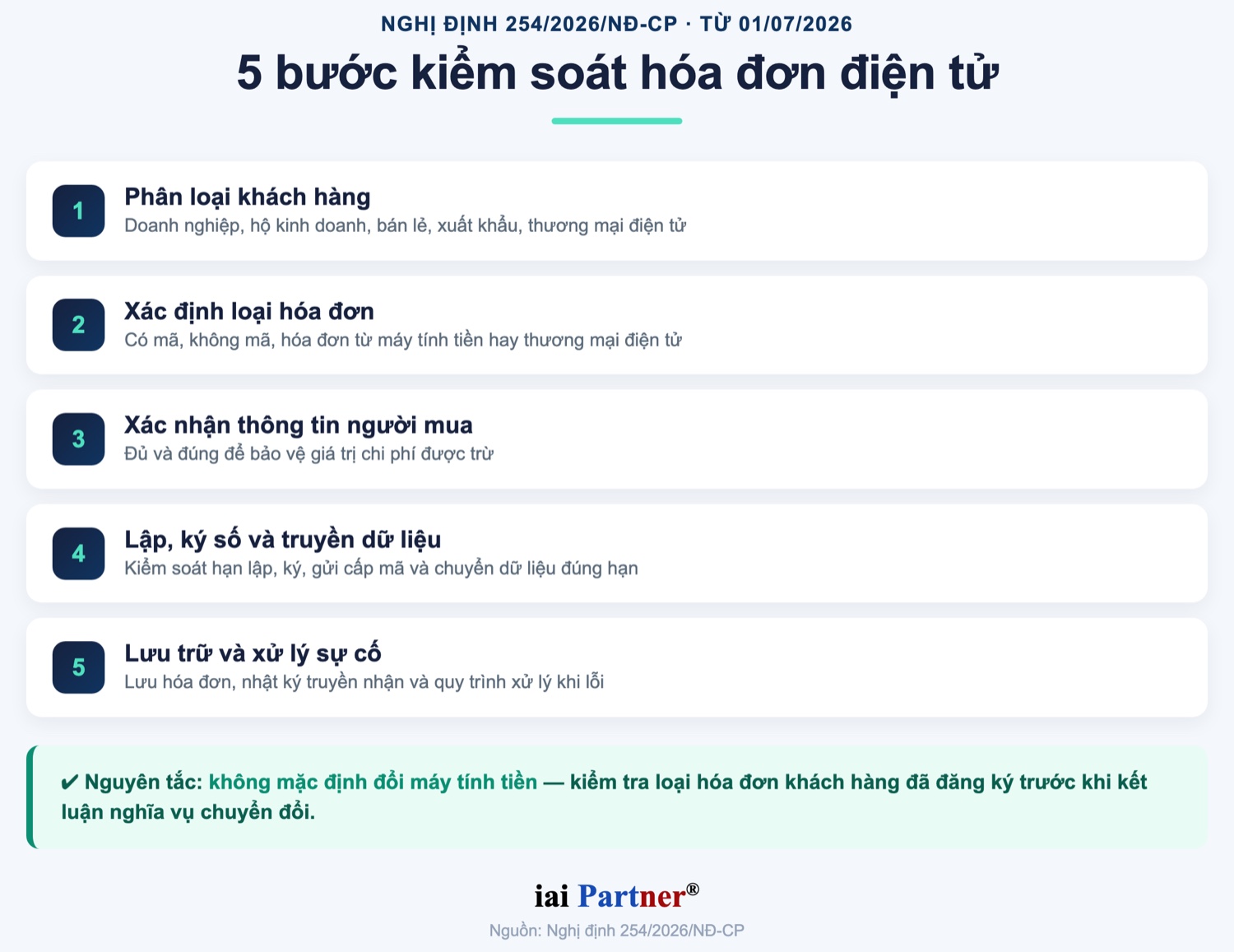
- Classify correctly: determine the invoice type — with code, without code, cash register, or e-commerce — before deployment.
- Invoice issuance time: a major risk point; issue by the transfer time, not only by the time of payment.
- Buyer information: determines the deductible expense value and must be confirmed before issuing the invoice.
- Do not default to cash registers: check the invoice type the customer has registered before concluding the conversion obligation.
Overview of changes enterprises should understand
Decree 254/2026/ND-CP provides detailed guidance on Tax Administration Law 108/2025/QH15 regarding e-invoices and electronic documents. According to the source material, the decree has 5 chapters, 45 articles, and an appendix on invoice contents. The new document terminates the old framework, including Decree 123/2020/ND-CP, Article 1 of Decree 41/2022/ND-CP, and Decree 70/2025/ND-CP. Therefore, enterprises should not merely update a few separate forms, but should review the invoice process from end to end.
From 01/07/2026, e-invoice governance should move from fragmented updates to unified process control.
Key changes compared with the old framework
The source material shows that the change is not only in the document title, but also in how operational obligations are systematized. Enterprises need to update legal bases in SOPs, contracts, checklists, and advisory files. E-commerce, digital platform, and cross-border customer groups also need closer review. For business households and individuals with annual revenue over VND 1 billion or selling assets requiring ownership or use-right registration, invoice application should be included in a separate checklist.
| Details | Old framework | Decree 254/2026/ND-CP | Operational impact |
|---|---|---|---|
| Document structure | Decree 123 was the base framework, and Decree 70 amended many articles | A new replacement decree is issued | Update legal bases in SOPs, contracts, and checklists |
| Legal basis | Based on the old Tax Administration Law and amending documents | Based on Tax Administration Law 108/2025/QH15 | Change cited legal bases in articles and advisory files |
| Invoices from cash registers | Decree 70 added the group selling directly to consumers | Clarifies that cases already using coded or non-coded invoices are not required to switch | Do not conclude that a form change is mandatory if the customer has valid registration |
| Business households and individuals over VND 1 billion | Rules were dispersed in the old framework | Must apply coded invoices or invoices from cash registers | Add the VND 1 billion revenue criterion to the business household checklist |
Classify the correct invoice type before implementation
A major risk is that enterprises too quickly conclude that all retail customers must switch to invoices from cash registers. The source material emphasizes that groups selling directly to consumers are not always required to change invoice form. If an enterprise has validly registered to use coded or non-coded invoices, its current status should be checked before any change. Correct classification helps reduce errors when onboarding customers, configuring software, and guiding the sales team.
| Subject group or transaction | Invoice form to note | Control note |
|---|---|---|
| Enterprises, economic organizations, business households, and ordinary business individuals | E-invoices with tax authority codes | A safe default option if conditions for non-coded invoices are not yet met |
| Sectors with information technology infrastructure meeting conditions | Non-coded e-invoices | Not applicable if in a high-risk group or already registered to use coded invoices |
| Retail, food and beverage, hotels, passenger transport, and personal services | E-invoices from cash registers | Registration status should be checked before concluding that conversion is required |
| Exporting goods or providing services abroad | E-commerce invoices or appropriate e-invoices | Depending on conditions for transmitting electronic data to the tax authority |
Invoice issuance timing is a common risk point
According to the source material, invoice issuance timing is emphasized in Article 9 and should be controlled by transaction type. Enterprises should not rely only on payment timing, because sales of goods and provision of services follow different principles. For multiple deliveries or acceptance by each item, invoices must be issued for the corresponding portion upon each delivery, acceptance, or handover. For goods exports, the seller determines the invoice issuance time, but it must not be later than the next working day after customs clearance.
| Transaction | Invoice issuance timing according to the source material |
|---|---|
| Sale of goods | When ownership or use rights are transferred, regardless of whether payment has been collected |
| Provision of services | Upon service completion; if payment is collected before or during provision, issue when payment is collected |
| Multiple deliveries or acceptance by each item | Each delivery, acceptance, or handover requires an invoice for the corresponding portion |
| Export of goods | No later than the next working day after customs clearance |
| High-volume services requiring reconciliation | Issue upon completion of reconciliation but not beyond the specific deadline for the sector or service type |
Buyer information determines expense validity
The new decree requires enterprises to communicate more clearly about buyer information before issuing invoices. When the buyer does not provide name, address, or personal identification number, the invoice may state “Sold to consumer”. However, invoices lacking buyer information or issued to consumers cannot be used for expense accounting or tax finalization by a buyer that is an organization, business household, or business individual. Therefore, the sales team should request information before issuing expense invoices, including name, tax code or identification number, and address as required.
If an invoice is needed as a valid expense, buyer information must be confirmed before issuance.
- Add a step to confirm buyer information before closing orders or issuing invoices.
- Configure alerts in sales software or accounting software.
- Standardize message templates requesting name, tax code, identification number, and address.
- Clearly distinguish final consumer transactions from transactions requiring expense accounting.
Digital signing, data transmission, and operational risk handling
The source document states that the digital signing time may differ from the invoice issuance time, but the deadlines for signing, sending for code issuance, or transferring data must be controlled. Enterprises should separate the milestones of invoice issuance, digital signing, code request, and data transmission in a daily checklist. For e-invoices without a code, the source document mentions cases of sending full data, a summary table, or a transaction information table. The average threshold of one million invoices per month for direct transmission should also be used to classify customers who transmit directly or through a service provider.
Another notable point is the reward for reporting failure to issue invoices. According to the source material, the maximum reward is 10% of the penalty amount and no more than VND 10 million per case. This increases the risk of consumer complaints if an enterprise issues invoices incompletely, late, or with incorrect information. Practical control means issuing invoices on time, keeping review logs, and having a clear incident-handling process.
Implementation checklist for enterprises from 01/07/2026
To adapt to this new framework, your business should start by updating the customer checklist and sales process. Each transaction needs the right invoice type, the right time, and data transmitted on schedule. The accounting, sales, customer service, and system teams must agree on their roles before applying. If the business still has paper receipts or printed invoices, it should plan to use, destroy, or convert them before the 2027 milestone according to the source document.
- Review the list of customers in the group selling directly to consumers.
- Check business households and individuals with annual revenue over VND 1 billion.
- Update the notice template requesting buyer information before issuing expense invoices.
- Configure the digital signing and data transmission process no later than the next working day.
- Review remaining paper receipts and printed invoices, and plan a suitable transition.
- Keep records proving force majeure events when data transmission incidents occur.
Recommendations from IAI Partner
Dear Valued Enterprise,
IAI Partner recommends that enterprises not wait until the effective date to update e-invoice processes. This document should be incorporated into sales, accounting, customer service, and system checklists.
Enterprises should review each customer group, invoice type in use, invoice issuance timing, and transmitted data. Export, retail, e-commerce, and business household cases should be assessed separately.
Need support? Enterprises may prepare current invoice processes, customer lists, and buyer information templates so IAI Partner can review them by risk group.
Early standardization helps enterprises reduce errors, limit invoices that do not qualify as expenses, and respond more proactively when tax authorities request explanations.
Sincerely,
iai Partner®
Source: IAI-Partner.com
Frequently asked questions
When does Decree 254/2026/ND-CP take effect?
According to the source material, this document takes effect on 01/07/2026 and applies to e-invoices and electronic documents.
Are retail enterprises required to switch to invoices from cash registers?
Enterprises should not conclude automatically. The source material states that current invoice registration status should be checked before determining conversion obligations.
Can an invoice stating “Sold to consumer” be used as a valid expense?
According to the source material, invoices lacking buyer information or issued to consumers cannot be used for expense accounting or tax finalization by a buyer that is an organization, business household, or business individual.
Need help? Contact IAI Partner
📞 Hotline: 033 944 7112
📧 Email: hi@iai-partner.com
🌐 Website: iai-partner.com