


Capital contribution to a joint venture in cash is a wording that can easily cause confusion in contracts, documents, and accounting records.
Businesses may contribute capital in money, but cash delivery and receipt between legal entities must be tightly controlled.

Understand the substance: contributing capital in money differs from paying in cash
In practice, many internal records still use the phrase capital contribution to a joint venture in cash. This wording may seem simple, but it can misstate the substance of the transaction. The issue is not that the contributed asset is money. The issue lies in the method of delivering and receiving money between businesses.
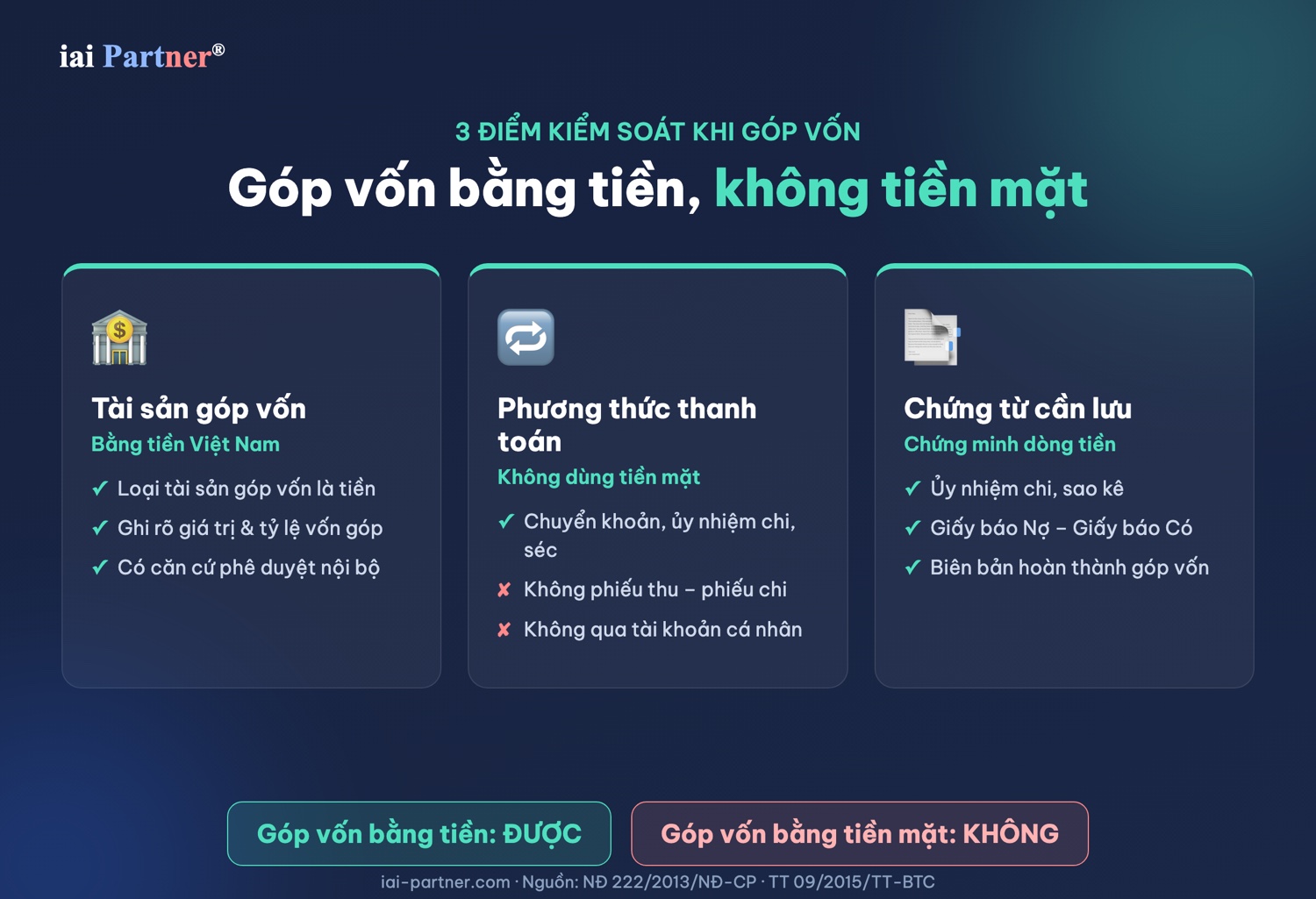
According to the source, a business may contribute capital in Vietnamese dong. However, when both the contributor and recipient are businesses, payment should be made by a non-cash method. Therefore, the records should clearly separate two matters: the type of contributed asset and the payment method.
Contributing capital in money identifies the contributed asset; contributing capital in cash is wording that can cause the transaction to be misunderstood in terms of payment method.
| Details | Correct understanding | Risk if recorded incorrectly |
|---|---|---|
| Capital contribution in Vietnamese dong | The contributed asset is money | Low risk if payment documents are proper |
| Capital contribution in cash | Can easily be understood as cash delivery and receipt | May create legal and accounting risks |
| Payment by bank transfer | A non-cash payment method | Payment orders and bank statements must be fully retained |

Authorities mentioned in the source and points businesses should note
The source identifies three groups of documents to monitor when handling capital contribution records between businesses. They include Decree 222/2013/NĐ-CP, Circular 09/2015/TT-BTC, and Decree 340/2025/NĐ-CP. The source emphasizes that the new sanctioning document does not replace the foundational rules on non-cash payment.
For transactions of capital contribution, purchase or transfer of capital portions between enterprises, the file must prove a legitimate cash flow. The documents should clearly show the remitter, the beneficiary, the transfer description and the basis for the contribution. This is an important control layer before the accountant records the transaction.
| Document | Content stated in the source | Role in the records |
|---|---|---|
| Decree 222/2013/NĐ-CP | Articles 3 and 6 | Basis for restrictions on cash payment in certain transactions |
| Circular 09/2015/TT-BTC | Article 3 | Guidance on non-cash payment methods |
| Decree 340/2025/NĐ-CP | Articles 5, 30, and 72 | The sanctioning document mentioned in the source should be checked before application |
IAI Partner recommends that businesses check more than contract wording. Businesses should also check bank accounts, document signatories, approval minutes, and the bank document set. A proper file must be consistent from the capital contribution decision to the payment documents.
How to draft contracts to avoid being understood as cash delivery and receipt
A common mistake is to state briefly that one party contributes capital to a joint venture in cash. This wording can make the file appear as if the business directly delivered and received cash. In reality, the business usually only needs to identify the contribution as Vietnamese dong.
Wording that should not be used
- Party A contributes capital to the joint venture in cash.
- Party A pays cash to Party B to complete the capital contribution obligation.
- The capital recipient issues a cash receipt for the business's capital contribution.
Wording that should be used
- Party A contributes capital in Vietnamese dong and makes payment by bank transfer to Party B's account.
- The capital contribution is made in Vietnamese dong through a non-cash payment method as prescribed by law.
- The transfer description should clearly state: Capital contribution under the contract or file number, date, and recipient name.
This drafting approach helps the file clearly distinguish the contributed asset from the payment method. It is a small wording point, but it directly affects how accounting retains documents. An imprecise phrase can create unnecessary explanations when the file is reviewed.
Records to retain when contributing capital to a joint venture in money
For capital contribution to a joint venture in money, the file should not stop at the contract. Businesses should retain approval documents, documents identifying contribution ratios, and bank documents. The purpose is to prove that the transaction is real, conducted by the correct parties, and paid through the correct method.
- Decision or resolution approving the business's capital contribution.
- Capital contribution agreement, joint venture agreement, or equivalent file.
- Charter, appendix, or document identifying the parties' contribution ratios.
- Payment order, transfer document, or lawful non-cash payment document.
- Bank statement, debit advice, and credit advice related to the capital contribution.
- Minutes confirming completion of the capital contribution obligation between the parties.
A key control point is that the remitting account holder must be the contributing business. The beneficiary must be the capital recipient business. Transferring through a personal account and then depositing back into the company should be avoided. This practice weakens the transparency of the money flow.

Practices to avoid in practice
Some businesses handle capital contribution transactions according to cash habits, especially when they need to complete files quickly. For example, the contributor issues a cash payment voucher, the recipient issues a cash receipt, or the director carries cash to deposit. These practices are not appropriate when the transaction occurs between two businesses.
- Do not use cash payment and receipt vouchers to replace transfer documents.
- Do not let the director, employees, or related individuals carry cash to deposit.
- Do not withdraw money from the business account and then deposit cash into the recipient's account.
- Do not transfer money through a personal account and then pay it back to the capital recipient business.
- Do not create transfer documents merely as a workaround if the actual transaction used the wrong method.
File handling should start from the substance of the transaction, not from the need to legalize documents. If the money flow used the wrong method, the business should review all contracts, receipts, payment vouchers, and accounting books. Hasty correction may make the file riskier.

How to handle it if cash was already delivered and received
The source recommends not legalizing the matter with a workaround transfer document. A more appropriate approach is to bring the file back to the correct legal substance. The business needs to re-present the non-cash money flow between the two legal entities.
- Review contracts, receipts, payment vouchers, accounting books, and related documents.
- Prepare minutes confirming that the transaction did not use the correct payment method.
- The recipient returns the amount received in cash.
- The contributing business transfers the amount again from the company account.
- Both parties prepare minutes confirming completion of the capital contribution obligation.
- Accounting adjusts the documents and retains a complete explanatory file.
Handling should involve coordination between accounting, internal legal staff, and the authorized representative. If the transaction is large or has passed through multiple accounting periods, the business should review carefully before adjustment. Each handling step must leave a clear record trail.
Recommended controls before signing and before accounting
Capital contribution to a joint venture in cash should not be a phrase appearing in contracts, minutes, or accounting documents. Instead, the file should record contribution in Vietnamese dong and non-cash payment. This wording is clearer, safer, and more consistent with internal control requirements.
- Check the wording in the contract before official signing.
- Check the remitting and receiving accounts before preparing documents.
- Write the transfer description with reference to the contract, file, or capital contribution resolution.
- Fully retain payment orders, bank statements, debit advices, and credit advices.
- Set up a review step before accounting records a capital increase or investment.
Need support? IAI Partner can accompany your enterprise in reviewing capital-contribution files, checking payment documents and standardizing the storage process. The goal is to reduce legal risk, reduce accounting risk and keep the file ready when explanation is needed.
Frequently asked questions
May a business contribute capital to a joint venture in money?
Yes. According to the source, a business may contribute capital in Vietnamese dong. However, for transactions between businesses, the payment method should be non-cash.
Should the contract state capital contribution to a joint venture in cash?
No. This wording can easily make the transaction understood as cash delivery and receipt. The file should state contribution in Vietnamese dong and payment by bank transfer.
If capital was already contributed in cash, should an additional transfer document be created?
A workaround document should not be created. The business should review the file, return the cash amount if appropriate, transfer again from the company account, and retain explanatory minutes.
Recommendations from IAI Partner
Dear Valued Enterprise,
IAI Partner recommends that businesses review all capital contribution agreement templates, joint venture agreements, and capital contribution confirmation minutes.
The files should consistently state capital contribution in Vietnamese dong and clearly specify the non-cash payment method.
Before accounting, the accountant should reconcile the remitting account holder, beneficiary, transfer description, and bank document set.
Sincerely,
iai Partner®
Source: Decree 222/2013/NĐ-CP · Circular 09/2015/TT-BTC · Decree 340/2025/NĐ-CP · IAI-Partner.com
Need help? Contact IAI Partner
📞 Hotline: 033 944 7112
📧 Email: hi@iai-partner.com
🌐 Website: iai-partner.com