


Payroll service is not merely preparing a payroll sheet at month-end. If input data is incomplete, personnel changes are unconfirmed, or deductions are unclear, a business may pay salaries incorrectly and lack supporting records.
With the IAI Payroll Service model, the process is designed around the principles of correct data, accurate calculation, prior approval, and complete storage. This approach helps your business control payroll risks, social insurance, personal income tax, and trade union obligations in each payroll cycle.
📌 Key points to remember
- Input data: most payroll errors come from missing or unconfirmed input data, not from the formula.
- 8-step process: from receiving records, timekeeping, checking, payroll calculation, approval, and payment to accounting and storage.
- Approve before paying: do not create a payment order until the payroll has been confirmed by the customer.
- Full handover of records: detailed and summary payrolls, pay slips, bank payment lists, and summaries of social insurance, personal income tax, and trade union.
- Risk control: reduce wrong payments, duplicate payments, missing documents, and errors in tax and insurance obligations.
🗂️ What the customer should prepare for IAI to handle everything
- Personal records: citizen ID, phone number or VNeID, the employee’s own bank account, personal tax code, and social insurance book if available.
- Salary policy: agreed salary, allowances, bonuses, KPIs, and probationary or official employment rules.
- HR changes: new hires, resignations, maternity, sick leave, and salary or position adjustments during the period.
- Deductions: advances, debts, social insurance, personal income tax, and trade union if applicable.
- Monthly timesheet: actual working days, overtime, paid and unpaid leave, sick leave, and maternity leave.
💡 No suitable timekeeping tool yet? Your business can consider the timekeeping solution long4.vn (part of the vuicuoilen.vn ecosystem) to standardize timekeeping data before handing it over to IAI for full processing.
What is payroll service in Vietnam?
Payroll service in Vietnam is a model in which a business outsources all or part of its payroll work to a specialized provider instead of handling it in-house. The provider receives timekeeping data, calculates salaries, deducts social insurance and personal income tax, prepares the payroll and hands over complete records for each period.
In Vietnam, regulations on social insurance, personal income tax, dependant deductions and trade union funds change frequently. Outsourcing to a professional payroll service helps businesses stay up to date with new regulations, reduce errors and keep employees' salary information secure.
Which businesses should outsource payroll services?
- FDI enterprises and foreign companies: need to comply with Vietnamese labor regulations but lack a payroll team familiar with local law.
- Representative offices and branches: have a small headcount and do not need a dedicated payroll department.
- Small and medium enterprises, startups: want to focus resources on their business and optimize operating costs.
- Businesses with high staff turnover: frequently hire, offboard and adjust salaries, making in-house processing error-prone.
Benefits of a professional payroll service
- Always-current compliance: apply the latest regulations on social insurance, personal income tax and trade union funds correctly.
- Reduced risk and errors: a cross-check process before finalizing the payroll and issuing payment orders.
- Salary data security: salary data is processed independently, limiting internal leaks.
- Cost and time savings: no need to invest in software, training and dedicated staff.
- Ready for finalization: payroll, insurance and tax records are fully retained, making year-end personal income tax finalization convenient.
Why does a business need a clear payroll process?
Payroll is a recurring expense that directly affects cash flow, costs, employee morale, and compliance obligations. An incorrect payroll sheet can lead to wrong payments, wrong accounting entries, and inconsistent filing data.
In practice, many discrepancies do not come from payroll formulas, but from input data. Outdated employee lists, attendance sheets missing leave days, or non-owned bank accounts can all create risks.
The core principle of payroll service is not to create payment instructions before the payroll sheet is confirmed by the client.
Deliverables of IAI payroll service
An effective payroll service must produce outputs for three goals: employees understand their pay, the business approves payment, and accounting has records for posting. Therefore, the deliverables should not stop at a single summary Excel file.
- Detailed payroll by employee and by each income, deduction, and net payment item.
- Summary payroll for approval, accounting, and payroll cost tracking.
- Individual payslips so employees can review base salary, working days, overtime, allowances, bonuses, and deductions.
- Bank payment list for reconciliation before preparing payment orders or bank uploads.
- Monthly accounting, filing, and storage records for lookup and explanation.
| Input group | Data to standardize |
|---|---|
| Personal records | Citizen ID, VNeID phone number, employee-owned bank account, personal tax code, and social insurance book if available. |
| Salary policies | Agreed salary, allowances, bonuses, KPIs, and probationary or official employment policies. |
| Personnel changes | New hires, resignations, maternity, sick leave, salary adjustments, or position changes. |
| Deductions | Advances, debts, social insurance, personal income tax, and trade union items if any. |
Eight-step process from intake to retention
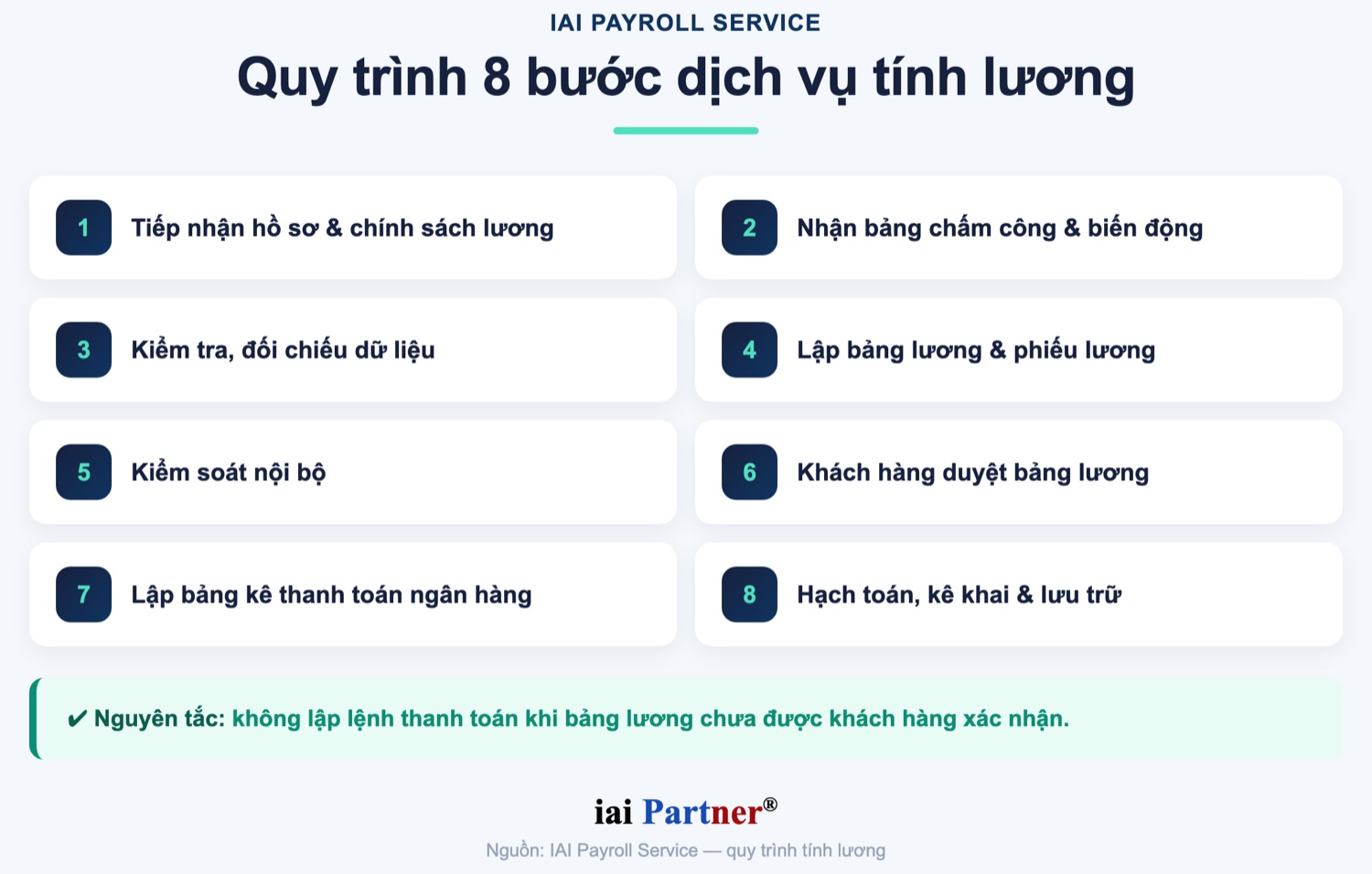
IAI structures payroll processing into eight continuous steps. Each step has its own control point to reduce input errors before discrepancies enter the official payroll sheet.
- Receive employee records and current salary policies.
- Receive attendance sheets, overtime data, leave, unpaid leave, and monthly changes.
- Check and reconcile employee lists, working days, social insurance, personal income tax, advances, and debts.
- Prepare detailed payroll, summary payroll, and individual payslips.
- Conduct internal control to detect discrepancies before sending to the client for approval.
- Send the payroll sheet to the client for review and final confirmation.
- Prepare the bank payment list after the payroll sheet is approved.
- Post accounting entries, handle related filings, and store records by month.
This process places approval before payment. As a result, the bank payment list is not prepared from a draft, and any post-approval adjustment requires notes to preserve an audit trail.
Pre-payroll checks: the key error-reduction step
The checking and reconciliation step is the most important protection layer in payroll service. When data is cleaned first, the payroll sheet requires fewer corrections and the business avoids overpayments or underpayments.
Items to reconcile before preparing payroll
- The employee list must match the attendance sheet to avoid missing or extra salary recipients.
- Working days, overtime, paid leave, and unpaid leave must be checked against actual data.
- Social insurance and trade union items should be reconciled based on eligible employees, contribution salary, and monthly changes.
- Personal income tax requires checking the tax code, dependents, taxable income, and deductions.
- Advances and debts must be updated correctly to avoid overpaying employees.
The expected result of this step is clean data before it enters payroll. This is the major difference between reactive payroll processing and controlled payroll management.
Safe payroll approval and payment
Payroll payment is a sensitive step because it directly involves money leaving the business account. IAI applies the principle that payments are not made from a draft, but only after final client confirmation.
| Before transfer | After payment |
|---|---|
| The total on the payment list must match the approved payroll sheet. | Retain the bank payment list for reconciliation when needed. |
| The recipient name and bank account number must match the employee. | Retain the executed payment order or transfer evidence. |
| The payment list must not duplicate employees or omit employees. | Retain the client’s confirmation email or written approval. |
Clear approval before payment helps reduce the risk of wrong payments, duplicate payments, or missing records after the payroll period.
Accounting, filing, and retention after payroll
After salaries are paid, the data must be posted to the accounting system and records must be stored in a clear structure. The goal is fast retrieval, explainability, and no dependence on a single processor.
- Record salary expenses, allowances, bonuses, and related items.
- Track social insurance, health insurance, unemployment insurance, and trade union fees if included in the records.
- Update periodic personal income tax data, dependents, and deduction records.
- Store records by client, year, month, payroll, attendance, payment, social insurance, personal income tax, and confirmation.
This is also the basis for monthly review of personnel costs. When records are complete, reviewing an old payroll period becomes much easier than searching across many disconnected sources.
Suggested monthly operating schedule
The operating schedule can be adjusted to each business’s actual payday. However, clear milestones help all parties know when to send data, approve payroll, and complete record retention.
| Timing | Main task |
|---|---|
| Day 25–28 | The client sends attendance sheets and monthly personnel changes. |
| Day 28–30 | IAI checks, reconciles data, and confirms unclear items. |
| Day 30–02 | Prepare payroll sheets and payslips for the control step. |
| Day 02–04 | Conduct internal control and send the payroll sheet to the client for review. |
| Day 04–05 | The client approves the payroll sheet before the payment list is prepared. |
| After approval | Process payment, post accounting entries, and store monthly records. |
Post-payroll handover checklist
After each payroll period, the handover package must be sufficient for the business to review, store, and reuse for explanation when needed. This checklist also reduces inconsistent monthly storage that makes later lookup difficult.
- Summary payroll confirmed by the client.
- Detailed payroll and individual payslips for each employee.
- Bank payment list and transfer evidence.
- List of personnel changes during the payroll period.
- Summary of social insurance, personal income tax, and trade union items if any.
- List of issues to note for the next payroll period.
- Monthly electronic records stored under a consistent structure.
Recommendations from IAI Partner
Dear Valued Enterprise,
Your business should view payroll service as part of the operating control system, not merely a month-end calculation task. The more departments payroll involves, the clearer the approval process and supporting records must be.
IAI recommends standardizing monthly input data, especially attendance, personnel changes, advances, debts, and bank information. When input data has clear sources, payroll calculation, payment, and accounting become safer.
Need support? IAI Partner can help build a payroll process, control data, prepare payroll sheets, prepare payment lists, and organize record retention suitable for each business.
Sincerely,
iai Partner®
Source: IAI-Partner.com
Frequently asked questions
What data does a business need to send for IAI to calculate payroll?
Your business should send employee records, salary policies, attendance sheets, personnel changes, and deductions for the period. These data points form the basis for payroll, payslips, and payment records.
When should payroll be finalized before payment?
Under the suggested schedule, the client approves payroll around day 04–05 after IAI completes internal control. This schedule can be adjusted to the actual payday of each business.
Does payroll service support accounting records and retention?
Yes. The deliverables include summary payroll, detailed payroll, payslips, bank payment lists, accounting records, related filing data, and monthly electronic records.
🔗 More related services and articles
- HR and payroll management service
- Social insurance service for businesses
- Business operations support service
- Decree 253/2026 on personal income tax
- Updating dependents to taxpayers
- Quarterly personal income tax declaration
Need help? Contact IAI Partner
📞 Hotline: 033 944 7112
📧 Email: hi@iai-partner.com
🌐 Website: iai-partner.com