


Tax extension 2026 helps businesses defer the payment deadline for certain taxes and land rent amounts under the regulations.
This policy is not tax exemption, so businesses must still declare, manage records, and monitor obligations fully.
What is tax extension 2026 and why should it be reviewed early?
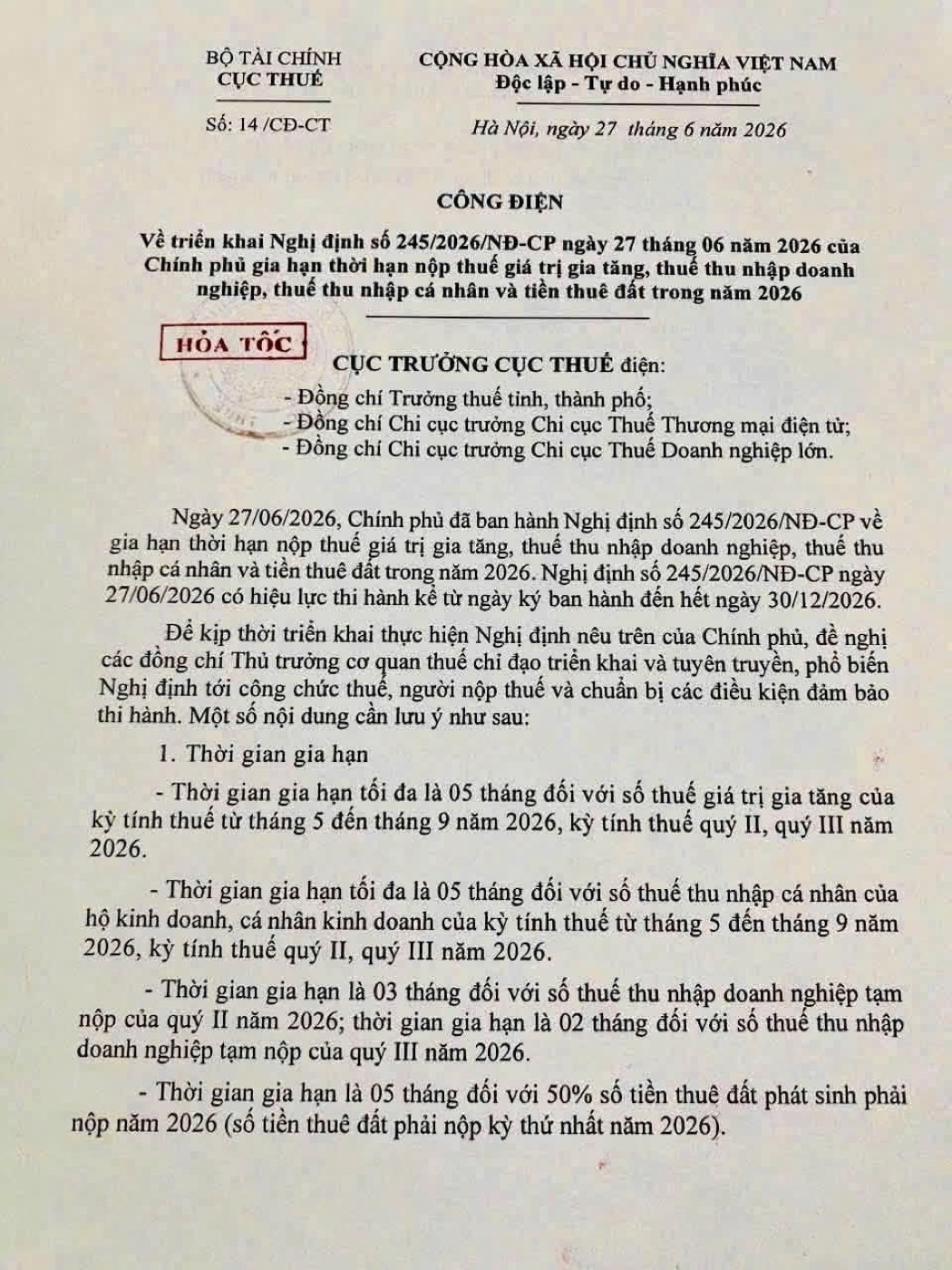
According to the source, the 2026 tax extension policy applies to certain taxes and land rent under Decree 245/2026/ND-CP, implemented by the Tax Department in Official Telegram 14/CD-CT. The goal is to help businesses, household businesses and individual businesses proactively manage cash flow in 2026. However, an extension only postpones the payment deadline; it does not remove the tax obligation. This point must be emphasized to avoid a very common misunderstanding during document handling.
Businesses need to review conditions before applying, instead of automatically assuming that all taxes are extended. Early review helps identify which amounts qualify, which periods apply, and which records are required. If processing is delayed until near the deadline, businesses may face information errors, missing confirmations, or system congestion. A beneficial policy can still become a risk if records are poorly controlled.
Tax extension is a benefit regarding payment timing, not tax exemption and not a replacement for filing obligations.
Taxes and land rent amounts that may be extended
The source states that groups that may be extended include VAT, PIT of business households and individual businesses, provisional CIT payments for Q2 and Q3/2026, and 50% of the land rent payable for the first period of 2026. Each group has different arising periods and extension periods. Businesses need to match the correct tax type, arising period, and applicable subject. Everything should not be bundled into one general conclusion, because that is very convenient for confusion.
Summary table of extension periods
| Tax or land rent amount | Eligible arising period | Extension period |
|---|---|---|
| VAT | May–September 2026 or Q2–Q3/2026 | Up to 05 months |
| PIT | Business households and individual businesses in May–September 2026 or Q2–Q3/2026 | Up to 05 months |
| CIT | Provisional CIT payable for Q2/2026 and Q3/2026 | 03 months or 02 months depending on the period |
| Land rent | 50% of land rent payable for the first period of 2026 | 05 months |

Extension request procedure and final deadline to note
According to the source, clients only need to submit the extension request once for all amounts eligible for extension. The document is submitted to the directly managing tax authority by an appropriate method. The final deadline for submitting the extension request is 02/11/2026. Even so, IAI Partner recommends that businesses should not wait until near this date to start preparing records.
The operating process should begin with reviewing applicable conditions, then preparing the request document and submitting it to the tax authority. Businesses need to determine whether they are eligible, which taxes arise in eligible periods, and whether there is land rent for the first period of 2026. If IAI supports submission, the business needs to agree on the plan, authorization, or suitable information. Finishing 5–7 working days before the deadline is a sensible choice, rare but highly recommended.
What information should businesses prepare?
For IAI Partner to review and support on time, businesses need to prepare information on filing periods and expected tax amounts arising. If there is land rent, the business needs to provide information on the land rent for the first period of 2026. In addition, the applicable subject, industry, operating status, and information used to prepare the extension request must be confirmed. This work sounds small, but one missing data point can freeze the whole file like an office printer during rush hour.
- Filing periods and expected taxes arising in 2026.
- Information on land rent for the first period of 2026, if any.
- Confirmation of applicable subject, industry, and operating status.
- Extension request document or information for IAI to prepare it.
- Authorization or agreed plan if IAI supports submission.
Points that should not be misunderstood when applying
The first point to remember is that extended amounts are not exempt amounts. Businesses must still monitor filing schedules, documents, taxes arising, and obligations after the extension period ends. If the business only focuses on the payment deadline and ignores filing obligations, tax records may still create risk. Extension is a cash flow management tool, not an accounting magic trick.
The second point is that businesses should not automatically assume that every tax is extended. Each amount must be checked against the specific subject and conditions in Decree 245/2026/NĐ-CP before application. For business households and individual businesses, PIT and the eligible arising periods need separate review. For businesses with land rent, the correct 50% of the land rent for the first period of 2026 must be checked.
Operational recommendations from IAI Partner
IAI Partner recommends that your business review its 2026 tax extension records as early as possible. Early preparation helps the business manage cash flow proactively, avoid missing any eligible items and reduce the risk of incorrect information in the request document. With the periodic tax declaration service, the accounting team should keep a separate tracking sheet for each tax, each arising period and the corresponding extension time. This approach helps management clearly see tax obligations by time, instead of looking at a single total figure.
Need support? Corporate tax accounting service by IAI Partner can help your business review eligibility, prepare information, draft the extension request and remind you of the deadline. For records with many taxes or many arising periods, having a separate control sheet is essential. A properly prepared extension file helps the business take advantage of the policy while staying compliant. In other words, using a good policy with clean records is still the least stressful approach.
Recommendations from IAI Partner
Dear Valued Enterprise,
IAI Partner recommends that businesses review 2026 tax extension conditions before preparing the request document.
Businesses need to prepare arising tax figures, land rent information if any, and confirmation of the applicable subject.
Do not wait until near 02/11/2026 to process it, because incorrect information or system congestion may delay the file.
Sincerely,
iai Partner®
Source: IAI-Partner.com
Frequently asked questions
Is tax extension 2026 tax exemption?
No. According to the source, extended amounts only have their payment deadlines deferred under regulations and are not exempt.
What is the final deadline for submitting the extension request?
According to the source, the final deadline is 02/11/2026. Businesses should complete review at least 5–7 working days before the deadline.
Does a business need to submit multiple documents for each tax?
According to the source, clients only need to submit the extension request once for all amounts eligible for extension.
Need help? Contact IAI Partner
📞 Hotline: 033 944 7112
📧 Email: hi@iai-partner.com
🌐 Website: iai-partner.com